http://www.bestphoneapps.mobi/?sl=213796-741ac&data1=Track1&data2=Track2

Sunday, 12 January 2014

Farm in the City- a Great Place with Cute and Tame Animals

At first, we couldn't believe where the farm is- Equine Park, Seri Kembangan, behind Giant Hypermarket... if it is true, then the farm should be surrounded by well developed residential and commercial areas. Well, as the name portrayed- Farm in the City, it is really a farm right in the middle of modern concrete buildings and highways. 

The entrance fees for MyKad holders were RM 30 for adult and RM 25 for child and senior citizen. Without MyKad, the entrance fees were RM 48 for adult and RM 38 for child and senior citizen. The complete address of the farm: Jalan Prima Tropika Barat, Bandar Putra Permai, Seri Kembangan. The operation hours for the farm were 10 am - 6 pm on weekdays, and 9:30 am - 6 pm on weekends and public holidays. The farm was closed on Tuesday except on public holiday.

We reached there at around 12 noon and stayed in the farm for more than 3 hours. The experience was good- we could actually touch, pet, and took close photos with almost all the animals in the farm. We were prohibited to bring outside food into the farm for the animals. For feeding, the animal food was available free of charge. Feeding time for some carnivorous animals and the schedule for animal show were available in the farm. Well, time to show our photos.


The signage to the farm was clearly displayed (upper left), which led us to a open space with a large "Downtown" entrance (upper right). There was ample of parking space (lower left). After the entrance, we need to turn right to enter the farm.

Our photo at the entrance of the farm.

The farm was very well landscaped. Photos showed the stairs right after the entrance (upper left), the giant tortoise exhibit (upper right), the farmer's hut by the lake (lower left), and the family resting area.

We could see the rare and exotics- albino crow (upper left), naturally white macaw (upper right), albino python, and Indian star back tortoise.

The members of old MacDonald's farm- big fat hen (upper left), pigeon (upper right), geese (lower left), and goats.

Of course, the cute animals were always the stars. We have Prairie dogs (upper left), Fennec Fox (upper right), the Flemish giant rabbit (lower left), and the striped skunk.

And of course, this super cute Prairie dog was one of the most eyes catching superstar!

The best thing about the farm- we could pet and touch the cuteness-overloaded animals :)

Parrots were very active.

There were many things to do- feeding and petting rabbits, deers, and giant tortoises were just a few of them. We could experience the moment of catching fish in longkang (drain) as well. These activities were "all included" without extra changes.

It is a great place for family, especially with kids. Experiencing close contact with various animals is invaluable. Just a rough count on feeding grounds- Aldabra and Sulcata tortoises at the Turtle and Tortoise Farm, rabbits and guinea pigs at the Pet Village, deers and goats at the Savanna, a cow at the Vegetables and Fruit Farm, and the fish and ducks beside the pond. All the animal food were free of charge.

We really need to put a thumb up for all the helpful and friendly farm keepers. They provided not only the information about the animals, but helped in distributing animal food to the visitors. They were animal lovers. We could see that from how they treated the animals. The farm was clean, but of course, couldn't be 100 % free of the smell of the animals.

To have an enjoyable trip, sufficient drinking water and comfortable footwear are necessary. Do allocate at least 3 hours for a relaxing tour around the farm. During our visit, the drink was available only at the canteen. There were flowing streams to be crossed, but the stepping stones were just nice to keep our feet dry. Throughout the trip, three of us just recorded with only one mosquito's bite, so it might not necessary for us to apply any mosquito repellent.

The Pet Village with rabbits and guinea pigs (upper left), the Savanna with tame deers, two world second smallest kangaroos, and two very naughty goats (upper right), fish feeding site (lower left), and the counter of the canteen.

Ducks came to share the food with fish.

The food at the canteen was nice. We tried tom yam with noodle, kampung fried rice, and mixed rice with drinks. The price, around RM10 per person. The canteen had an air conditioned section, which was fully booked during our visit. The open air section was very simple, but there were enough ceiling fans to keep us away from afternoon heat. The whole farm was heavily shrubbed so umbrella was necessary in case of raining only.

It will be perfect if the entrance fees can be a bit cheaper, and the toilets, a bit cleaner (of course, we couldn't really complain much about farm's toilets). And, the Vegetable and Fruit Farm need a bit more improvement. Visit again? Definitely.

Our sharing on attractions in Selangor are available at:


Thursday, 9 January 2014

Ayyappa - Protector of Natural Law

Ayyappa:
Ayyappa is a famous Hindu deity who is popularly worshipped in South-India. It is estimated over 50 million people reach the temple every year to seek blessings of the Lord Ayyappa on the day of Makar-Sankranthi or Pongal. The most famous Lord Ayyappan shrine or temple is located at Sabarimala, on the hills of Pathanamthitta in Kerala,India.

Cultural beliefs:
Ayyappa was found on the banks of River Pampa. He was adopted child to Pandala King(Rajashekhara) and cured the deaf and dumb of Teacher’s(Guru) son. Due to evil manipulations of his step mother, he went to forest and killed demoness Mahishi and came to kingdom riding on tiger for giving milk of tiger to his step mother. After that he went to dense forest and disappeared. Upon the instructions of Ayyappa, King built temple for Ayyappa in Sabarimalai. Sabarimalai means Sabari- the devote of Ayyappa and malai- the hill. Sabari, the devotee of Ayyappa had become a hill for the place of stay for Ayyappa.
 
There is spiritual relation existed between Lord Ayyappa and Lord Saturn. After watching troubles caused by Lord Shani to his devotees he suggested Ayyappa deeksha for 41+ days(mandalam) as remedy for all the troubles of Lord Saturn. These 41+ days Lord Ayyappa devotees experience all the difficulties to please Lord Saturn and reach Lord Ayyappa Temple by wearing black cloths as the symbol of Lord Saturn.
 
When Ayyappa learning war fighting tactics(Kalari Vidya) under guru panicker (last name of Kaniyars community of Kerala,who are teachers). Teachers daughter 'Nila' fell love with Lord Ayyappa and asked to marry her. But Lord refuges marry her by explaining his misson as Bramhachari(bachelor) to kill demon Mahishi.
 
Interesting facts:
  • Lord Ayyappa was born to Lord Shiva and Lord Vishnu (Mohini Avatar) hence he is called as "Hariharasutan".
  • He born wearing Mani( Jewel stone or bell) around his neck hence he is called as "Manikanta".
  • The 18 steps to reach god are considered as Holy steps and indicates five senses,eight desires,3 behaviors,knowledge and ignorance. Act of crossing these steps is considered as sacred and bestows with self-realization.
  • According to Buddhism, Ayyappa is form of Dharma-sastha.
  • The original idol at sabarimalai temple was installed by Lord Parasurama.
  • Sabarimalai hill was the place where Sabhari lived and Lord Rama visited.
  • Makar Jyothi is a star which is worshiped by devotees as the form of Ayyappa on Makar Sankranthi day.
  • Makara Vilakku is sacred fire which appears on the top of hills near by the temple.
  • Thiruvaabharanam are the sacred gold ornaments of Ayyappa which are carried to temple before Makar sankranthi(around jan12th every year) and taken back to Pandalam temple after finishing of pilgrim season.Garuda (holy eagle) is the guardian of the ornaments.
  • Sabarimalai temple officially uses K.J.Yesudas famous singer voice for 'Harivarasanam' song which was recited before closing the temple every day.'Ayyappa Suprabhatham' is another song used as wake up song for Lord.
  • 'Nirajanam', Abhishekam with Ghee, Chanting Ayyappa names by taking Ayyappa Manadala Deeksha is sacred to get rid of bad influences of Lord Saturn.Hence he is called Shaneeshwaran Ayyappan.
  • 'Irumudi' is the travelling kit of devotees which keeps worship articles such as ghee coconuts, sandal, vibhooti, jacket pieces with the wishes written on it..
  • 'Aravana-payasam' is a sweet which is favorite to the Lord.
  • 'Arddhasana' is the yogic sitting posture of the lord explaining he have no wife nor sons to sit on his laps. Some says it the posture of meditation with consciousness and observance. As Ayyappa, he is a bachelor but, as Manikanta he has 2 wives called Poorna and Pushkalamba.
  • Names Of devotees according number of times they wear Ayyappa mala Kanni Swamy,Kathi Swamy,Ganta Swamy,Gada Swamy,Peru Swamy,Jyothi Swamy,Surya Swamy,Chandra Swamy,Trishula Swamy,Vishnu chakra Swamy,Shankadhara Swamy,Nagabharana Swamy,Srihari Swamy,Padma Swamy,Sri Swamy,Sri Sabari(Rathigiri) Swamy,Omkara swamy,Narikela Swamy(Guru)
  • Only Guru can give mala to other devotees
Scientific Reasons:
  • Humans show much interest in wearing colorful cloths in daily life. But, devotees of Lord Ayyapa wear unattractive black cloths.Exact reason is people will wear Ayyapa Mala in winter season(especially Karthika Masam) and black cloths will absorb heat and protects the body from cold climate. And black cloths will hide the people from wild animals at night when they travel in sabarimalai forest for seeing Ayyappan. Black color is favorite color for Lord saturn by wearing black cloths the Lord will be pleased and blessed the devotees.
  • People wear rudrakshas , Spatika, Tulasi, Sandal wood, Coral,Lotus beads as jewellery around the neck at the time of Ayyapa Deeksha.  Rudrakshas will control anger and lowers Blood pressure. Tulasi beads lowers extra heat, Sandalwood beads will remove unwanted thirst from the body, Spatika(Crystal) beads will absorb toxins from the body, Coral beads makes uniform blood flow in body, Lotus beads will eliminate skin diseases from the body.
  • People will wear this Ayyapa Mala and continue it for 40+ days and reach Ayyappa temple in Kerala state. These 40+ days called as Mandala Deeksha and it is compared to 27 stars + 12 Zodiac signs + 9 Planets = 48 days. Internal meaning states that people who wear Ayyapa Mala need to overcome all the affects of stars, zodiac signs, planets and reach the lord with pure devotion. Many of the Ayurveda treatments also have a span of 41+ days. Devotees take deeksha for 41 days and start for the yatra to sabarimalai and return home with the mala and in total it would cover 48 days.
  • People who wear Ayyappa Mala will be respect the all human beings by calling with the name of God as 'Swamy'. They bow to the people who wear Ayyappa Mala. This practices will remove Ego in one and shows the world in equal manner. People in deeksha shouldn't apply oil to hair, should not shave and lead simple life by quitting all bad habits in these 41+ days period which explain about leaving ego, pride and victory over them with self control. People need to wake up at 4AM in the morning which is called 'Bramha muhurta' where the brain cells can perform in higher magnitude and fills our body with new life force.
  • By litting camphor, the smoke arose from camphor will clear our sinus this is the main reason devotees worship Lord Ayyapan twice a day by litting camphor. Cold water baths have many medicinal benefits in winter and explains leaving worldly comforts by controlling mind to see the Lord.Leaving spicy,hot and salty tastes and eating nature food(sattvic food) which is easily digestible will raises immunity power and controls the mind and thought process. Preparing food by self and omitting outside food will explain good hygiene protecting from various contagious diseases which spreads in winter.
  • Walking with bear foot without using sandals will acts as treatment of acupuncture and controls blood pressure. It adopts the procedure before climbing the hill at sabarimalai temple. Sleeping on floor will relieve various ailments in body due to earths magnetic force.
  • Performing Japas and Bajans with group of devotees and attending to meals offered by devotees will makes the person socially active by giving equal importance to people irrespective of caste, religion, race and social status.

Tuesday, 31 December 2013

OM - The Mystic Sound

OM :
OM is most sacred sound of Hinduism and also referred as Omkaram. In Sanskrit it is described as Pranava-Nadha means primary or root for all sounds. It should be pronounced as A-U-M. Every mantra in Hinduism OM is added at the beginning and ending phrases to acquire power to that mantra.

Cultural belief:
Hindus believe that the letters (A-U-M) in OM represents 'Trimurthi' (Lord Shiva,Lord Vishnu and Lord Brahma) . The sound removes all sorts of worries,sins and brings inner peace to chanter.  OM is Un-Manifested form of Lord.Om is considered as origin,center and end of everything. Om is the only sound that makes a person to reach peak of spiritual life and shows supreme reality. The planets which revolve around the sun make a noise which is called as OM.  Chanting sacred OM synchronizes the body with the vibration of the universe.OM is considered as NAME and FORM of absolute.Chanting OM purifies the mind,soul and creates inner peace. Ancient texts state that OM is 'Anahata Nada' (The sound that is not produced by striking two objects). According to the Maitri Upanishad OM represents the primeval vibration of Universe, OM is the Center of the Universe. OM is the seed of infinite knowledge.


Interesting facts:

  • Om is considered as mother of all mantras and treated as sound of all sounds.
  • OM represents three levels of consciousness(waking, dreaming, deep sleep).
  • OM represents the past, the present, and the future in the Mandukya Upanishad.
  • OM represents A - conscious, U - subconscious, M - unconscious
  • OM is the mantra used in meditation to focus the mind.
  • OM is a combination of a vowel(A-U) along with a nasal consonant(Mmmm..).
  • OM makes respiratory rate equal to the rate in balanced and relaxed state.
Scientific Reasons:
  • Chanting OM(A-U-M) produces nitric acid and brings more oxygen to the body.
  • Electro-Magnetic waves are generated in the body.
  • chanting OM gives creativity and happiness.
  • Sound waves of OM transforms water into 'Sri Yantra' Which was explained scientifically using Cymantics phenomena.
  • Chanting OM regenerates and gives new life to body cells and acts as an anti aging agent.
  • The vibration effects prominent change on the endocrine glands.
  • The sound gives power to heart,lungs,free blood circulation, digestion and acts as a detoxifying agent.
  • Chanting OM makes breath slow and steady in a controlled manner and relieves stress.
  • Allopathic research has stated that chanting of vowels and nasal constants (A-U-M) produces interleukin-2 in the body, which has power to suppress pain and reduces tension, anxiety and fear.
  • Chanting OM increases physiological alertness and increased sensitivity to the sensory transmission.

Monday, 30 December 2013

Lord Shani - Deliverance of justice

Lord Shani:

Planet Saturn is called as Lord Shani and weekday Saturday is dedicated to Lord Shanidev.Lord shani is also called as Chayaputra or Raviputra as he is born to Lord Surya and Goddess Chayadevi.'Shani tryodasi' which comes with tryodashi (Lunar day of Hindus) on Saturday, 'Shani Amavasya' which comes on new moon day Saturday are considered as auspicious days for worshiping the Lord. New moon day which comes on Vaishakha or Jyaishta month according to Hindu calendar is considered as the birth anniversary of Lord Saturn. Planet Saturn is powerful giver and destroyer.

Cultural belief:

 
Lord Shani was believed as a form of Lord Shiva. Lord Yama(death god) is elder brother of Lord Saturn.Shani puja on Saturdays will please Lord Saturn and will be blessed with removal of hardships.Shani Tilabhishekam,Shani Pradosh Vratam,Shani Tila puja,Shani hawan and Shani Shodashopachara poojas  are considered as very much auspicious. Shodashopachara pooja(
16 steps of prayer) is considered as the powerful prayer which is explained below.

Achamana — water sipping 3 times for self purification.
Pranayamam - breathing exercise.
Ganapati Prayers — Prayer to Ganesha to remove obstacles.
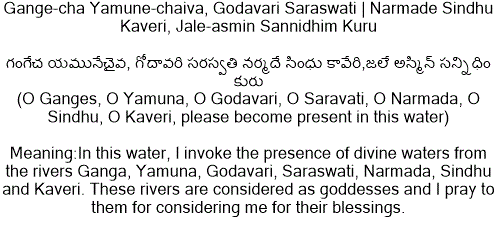
Kalsha - Inviting waters of all rivers into pot.
Sankalpa — declaration of intent.
Ghanta — Ringing bell(welcoming God)

16 steps of worship:
Dhyana or Avahana - Inviting the Lord Saturn
Asana - offering seat to sit.
Paadhya - offering water to wash the feet.
Aarghya - offering water to wash hands.
Aachamana - offering water to drink.
Madhuparka - offering sweet welcome drink.
Snana - Bathing should be done by pouring sesame oil or full ripe coconut water by reciting Sri Rudram or Purusha Sooktam or Sri Suktam. Pouring oil should be stopped after completion of one of the selected mantras. Unfortunatly, if oil was completed bathing should be continued with coconut water or simply water.
Vastra, Upaveeta - Offering Black Cloth to Lord.
Gandha - Offering Sandalwood paste for fragrance(like scent).
Pushpa - offering flowers with sesame seeds by praying Lord with 108 names('Ashtothara Sathanamavali').
Dhoopa - Lightening incense sticks.
Deepa - Lightening lamp using black wicks or specially made wick using black cloth & sesame seeds.
Naivedya - offering food (Sweet balls made with jaggery and sesame seeds, coconuts or banana's)
Taambula- offering betel leaf with areca nut.
Aarati - offering camphor light.
Mantrapushpa, Pradakshina - offering flower powered by mantra and doing circumambulation.

Interesting facts:

  • Shani Shingnapur temple in Maharashtra is very famous for Lord Saturn, there the God self emerged from earth as black stone.In this village, houses are with no doors.
  • Shri Mandeshwara Temple in East Godavari district,AP is very famous temple where Lord Shiva blessed Lord Saturn for his capabilities.
  • Lord Saturn rides on Iron chariot and mounted on Crow.
  • According to astrology, Lord Saturn in 7th place of Horoscope considered as strong.
  • Aquarius and Capricorn are the zodiac signs ruled by Lord Saturn.
  • Taurus and Libra are the zodiac signs where Lord Saturn is most beneficial.
  • Elinati Shani or Sade Sathi is the period of 7.5 years of transit of Lord Saturn considered as powerful.
  • Peepal tree has strong influence of Lord Saturn so it should be touched only on Saturdays to get positive results. 
  • Prayer of Lord Hanuma with 'Hanuman chalisa' on Saturdays also pleases Lord Saturn.
Scientific Reasons:
  • Astrology connected metal iron to Saturn and called Mandhagaman (means very slow). Science found ferrous (iron) oxide on Saturn.
  • Saturn takes 22.7 years to complete one rotation around sun.
  • In Germany,Scientists observed the room with microscope where group of people chanting 'Sri Rudram'.They found electrons flowed in the room in the form of Shiva Linga.  Mantras like Rudram,sooktam have direct healing and relaxing effect on people in the surroundings.
  • Mr.Sathish Chandra explained power generation using 'Poorusha-Sookta'.
  • Recent researches said that Hanuman Chalisa explains accurate distance between Sun and Earth.
  • If we do head bathing by applying sesame oil all over the body can cure several skin diseases.
  • Sesame seeds contains Vitamin-E, Vitamin-B, Calcium, Magnesium and fiber which give healthy benefits to the body.
  • Black cloth absorbs heat from environment and gives heat to body. Sesame seeds give heat to body.
  • The whole prayer for Lord Saturn passes a valuable healthy habits to generation by generation.

Saturday, 28 December 2013

Bathing - An Ancient Method of Body Cleaning - II


Bathing:
Bathing is an important daily ritual in Hinduism. Every person belonging to Hinduism will complete the ritual daily 1-3 times. Oil bath(Abhyangana Snanam) is one of the ancient techniques in bathing. Coconut oil, Cow Ghee, Castor oil or sesame oil with a special homemade bath powder(Nalugu Pindi) are used in this special type of bathing. One of the oils is applied on the body and gently massaged to all parts of the body which should be done for 30 minutes. Later after massage, the bath powder is used as the cleansing solution on the body. By this bath, several skin diseases, toxins, bad odors would be eliminated. This bathing benefits with good sleep, nourishes the skin, improves digestion and gives strength to all parts of the body.

Cultural Beliefs:
 According to Ancient texts, there are 5 types of bath.
1)'Nitya snan': Normal bathing ritual which is performed daily.
2)'Nimittika snan': This is performed after completion of certain types of situations like after eclipse, vomiting, saloon, bad dreams, sex, touching bones, visiting cemetery, touching women after pregnancy, touching women at the time of menstrual period, touching a dead person.
3)'Kamya Snan': Completing bath with a desire like bath while visiting a temple, festivals, important days, Karthika masam, important days.
4)'Mukya Snan': It is subdivided in to 2 types.
  • 'Mantra or Brahmya snan': Sprinkling water which are powered by sacred mantras like Purusha Sookta of Lord Vishnu, Namaka-Chamkam of Lord Shiva, Marjana mantras such as 

  • 'Varunam': This is the normal bath which we daily perform.
5)'Amukya or Gowna Snan' : Taking bath without water. This is subdivided into 5 types.
  • 'Agneya Snan': Taking bath with sacred ash. It is also known as Vibhuti Snan.
  • 'Mruthika Snan': Taking bath with Mud which is available at rivers or mud of snake house/ Hillock. It is also known as mud bath.
  • 'Vayuvya Snan': This snan is like when we  walk in the dust generated by group of cows nearby.     
  • 'Divya Snan': Taking bath in rain which arrives in a bright sunny day. 
  • 'Manasik Snan': Doing meditation by remembering God is considered as sacred bath.
Bathing effects on each week day:
  • Taking head bath on Saturday will fulfill all wishes.
  • Taking head bath on Sunday will increase thirst in the body and creates unwanted desires.
  • Taking head bath on Monday will improve beauty and gives peace.
  • Taking head bath on Tuesday will give sadness.
  • Taking head bath on Wednesday will improves financial assets.
  • Taking head bath on Thursday will give debts.
  • Taking head bath on Friday will give obstacles.
Results of Bathing when some ingredients are added:
  • Oil bath with warm water will make skin soft and regulates blood flow.
  • Sauna or steam bath will clean skin pores and increases oxygen levels in the body.
  • Taking bath using turmeric powder act as antiseptic and anti-bacterial.
  • Taking bath using cow ghee increases life span.
  • Taking bath with holy grass/ Kush grass will eliminate all sins.
  • Taking bath using sandalwood paste increases wealth.
  • Taking bath with Indian gooseberry will eliminates poverty.
  • Taking bath with sesame seeds or white mustard seeds will clear obstacles.
  • Taking bath with gem stones gives victory.
  • Taking bath with gold improves intelligence.
Interesting Facts:
  • Every person while entering into temple sprinkle some water on head as a act of purification and treated as bathing. This type of bathing is known as 'Bramha Snan' and stated in 'Padma-Purana'. It also used in the critical time when ever people had no facility to perform bathing while visiting sacred temples or places.
  • In-front of every popular temple, we see a water body(river, lake, pond, tank, ocean) for the purpose of bathing ritual.
  • Famous Lord Vekateswara Temple in tirumala, we can see water body called as 'pushkarini' considered as sacred and possess mystic energy due to idol bath with sacred mantras were done in the tank it is known as 'Chakra Snanam'.
  • In ancient days, people tested the rain water by collecting rain water in a silver bowl and dipping a small part of cooked rice in the bowel. If the rice was spoiled after sometime in bowel of rain water they will not use the rain water for bathing.
  • Oil bath/Head bath shouldn't be attempt on days of death ceremony, Sunday,Tuesday, Hindu lunar days of 'Padyami, Chavithi, Shahti, Ashtami, Navami, Chaturdasi' stated by 'Sukha Maharshi'.
  • Bathing at the time of 4-5AM is known as 'Rushi Snan' which is considered as auspicious.
  • Bathing at the time of 5-6AM is known as 'Deva Snan' Which is considered as normal.
  • Bathing at the time of 6-7AM is known as 'Manushya Snan' which is considered as least.
  • Bathing after 7AM is known as 'Rakshasa Snan' which worst of all.
  • Bathing in flowing waters like rivers is considered as auspicious. Males should do bath opposite to direction of flowing water.females should stand parallel to flowing water.
  • Bathing in ponds,lakes is considered as normal.
  • Bathing at well considered as least.
Their is a popular belief that taking bath in the waters of Rama Setu(Adams bridge),'Rameshwaram/Dhanshkoti' will be blessed with pregnancy.

Scientific Reasons:
  • Bathing will adjust the energies in our body and makes the energies in our body to flow uniformly and it is known as electro-magnetic activity.
  • Bathing will eliminate dust,toxins on the body, relieves stress,relaxes muscles and reduce body pains.
  • Bathing eliminates bad odor and gives freshness to mind.
  • Many scientists stated that waters of Ram-Setu/Adams bridge contains deposits of Gold, Silver, Aluminum and mercury. Whenever a couple takes bath in the water which are enriched with minerals will have chances of pregnancy in women.
  • River water will carry so many minerals because it flows from hills and touches so many herbal trees. People will be benefited physically and mentally when taken a dip in the sacred rivers.
Read More at :                       

Bathing - An Ancient Method of Body Cleaning - I


Wednesday, 25 December 2013

Food in Johor Bahru- Tan Hiok Nee Road and Eight Lido

Tan Hiok Nee was a rich and famous person in Johor Bahru (JB). Born in 1827, he had a humble beginning as a small textile retailer but his turned to be the most prominent businessman after sultan of Johor granted several concessions to him. Well, we are not going to have a history class here. You can find more information about Tan at Wikipedia. 

One of the streets at the center of Johor Bahru has been named Tan Hiok Nee Road to commemorate his contribution to the state. Tan Hiok Nee Road is located at the southern end of Wong Ah Fook Road, around 400 meters south from JB City Square. Streets nearby are Dhoby Road, Pahang Road, Trus Road, and Segget Road. Parking our car was the biggest problem around the area. The streets were always congested and we had to park our car a few streets away. Illegal parking might be risky as we noticed frequent policemen patrol around the area. A feast ended with a fine ticket on the windscreen was the last thing that we wished. In our last visit to JB, we went to the street two consecutive days for food and we would like to share what we found at Tan Hiok Nee Road.


Tan Hiok Nee Road has been transformed into a Chinese cultural and heritage street.

The street was well decorated. We saw a few people did some drawing in front of the shop lot (lower left). A wall with the words "It is more blessed to give than to receive"- a verse taken from the Holy Bible (lower right).

The arch of Tan Hiok Nee Road was flanked by two kopitiam. By random, we visited the left one- Kedai Makan Old Street Corner (upper left). The kopitiam had enough ceiling fans to keep us cool in the middle of the day (upper right), and served several traditional Chinese delicacies which for us, up to the standard to be recommended to all of you. By the way, the coffee served, both hot and cold were really good.

The shop next to Old Street Corner- Hiap Joo Bakery and Biscuit Factory attracted our attention with the people gathered outside of the shop (upper left). Well, the bakery was unique with the baking done by a big brick-made oven heated by firewood (upper right). Yes, wood! The old-fashioned oven was so big that it took up more than half of the shop (lower right). Well, we were lucky to grab ourselves one box of banana cakes (with RM8). The taste- excellent! As the factory only bake the bread once in a day, so we will see the queue only when the bread is almost done during the noon time. For the rest of the time, we can get other products such as buns and cakes quite easily. Hiap Joo which operated since 1919 was rated 5 out of 5 in Tripadvisor. The location- 13 Tan Hiok Nee Road.

We tried the noodle with beef tripe (lower left) and beef (lower right) at Triple K. Both were excellent. Well, one down side- the shop was warm even with the air-conditioners on. The shop seemed to be renovated, but the back side of the shop looked unappealing. Recommended? Yes, but be prepared to be sweaty. Anyway, the shop is located at the opposite side of Hiap Joo Bakery at 65, Tan Hiok Nee Road. Price per person was about RM10.

The shop was old. The owner had been cooking Teow Chew noodle there since 1969. According to the newspaper cutting, the soup for the noodle was cooked with firewood. We tried the dry noodle and noodle with soup. The noodle was good, but the overall taste were not what we had expected. The soup was a bit tasteless (for us). Well, that's Teow Chew noodle. If you wish to try some, please visit Kedai Makanan Sang Heng at 7, Tan Hiok Nee Road (beside HSBC Bank). Price per person was around RM5.

IT Roo was crowdy during lunch hours. The air-conditioning room was fully occupied during our visit. No choice, we took a table outside the shop. It was warm. Dubbed itself as "the best chicken chop in town", haha, it could be more appropriate to state as "the cheapest" with the price range from RM15 - RM25 per serving.

The air conditioned room was fully occupied (upper left), with some decorations on the wall (upper right). We tried steak with black pepper gravy (lower left) and roasted chicken chop with mushroom. The taste, to be frank, second upper. However, by putting the price and the location into our consideration, we might visit it again. IT Roo is located at 17, Dhoby Road (corner lot at the junction with Pahang Road).

If you happen to make a brief stop at JB, we would recommend that you grab some banana cakes from Hiap Joo Bakery and take a cup of coffee at Old Street Corner. If you opt for a more filling meal, then Triple K is a good choice. How about IT Roo? A big yes if you are fancy about western food, particularly chicken chop with fair price. Anyway, frankly speaking, we can get nice chicken chop all over Malaysia (price is another story), so in case you have travelled a thousand miles to JB, we would suggest that you should try something more "indigenous". You can find out more about our sharing on nice food in JB here.

Not to forget one more place that we visited for nice Spanish food- Eight Lido. Our friend Chia En recommended us to visit the nice British-style bungalow at Lido Beach for its nice environment. Well, she was right, that place was excellently decorated on the inside and well landscaped on the outside. But we almost left immediately after we knew that it served Spanish food. Come on, going to JB for Spanish food just didn't make sense to us. 

However, after a short discussion, Kelly urged us to stay, as she mentioned that if we wish to just take a try on Spanish food, that will be our best chance, for the price for the same type of food minus the nice environment in Kuala Lumpur cost double the figures in the menu. Well, too bad, we stayed and took Spanish food in JB.

Alright, the price was half compared to Kuala Lumpur, how about the quality? We had never tried Spanish food before but Kelly did, for a few times. Her comment- excellent. The food tasted authentic with unbeatable freshness. 

 The smoking section of Lido Eight. The non-smoking section was fully occupied during our visit.

 The outdoor dining area facing the strait.

Food for our dinner- Costilla de res estofada en salsa de vino tinto (braised beef ribs in red wine sauce) (upper left), Paella arruz negros (Rice and seafood with squid ink) (upper right), Gambas frescas con chile ajo y aceite de oliva (fresh prawns with chilli pepper, garlic and olive oil) (lower left), and Croquettes de pollo y queso (chicken and cheese croquettes with honey mustard). Together with the drinks, we spent around RM50 per person for the first-time-in-our-life spanish dinner. If you wish to try something not local to JB, such as Spanish food, then Eight Lido is definitely the place for you! The location, 8, Skudai Road (facing the strait). Open time was 6 pm onwards. We would like to thank Allan, the owner of Eight Lido and his crew for the great services. 

More about our experience in Johor Bahru can be found in our previous posts: