http://www.bestphoneapps.mobi/?sl=213796-741ac&data1=Track1&data2=Track2

Tuesday, 13 December 2011

Penang World Heritage Site Part 2

Penang World Heritage Site is located in George Town. We started our exploration from Chulia Street to Light Street before we took our lunch. Then, we continued our journey into Lebuh Pantai (Beach Street). It is one of the oldest street in George Town. Along the street, we saw banks, food shops, eateries, boutiques, and many more. We visited Peranakan Mansion, Little India, and Khoo Kongsi which are located in vicinity to the street.

We passed by Standard Chartered Bank after Penang Clock Tower. We took our lunch at the Kopitiam beside Standard Chartered Bank.

Penang Peranakan Mansion is a building in light green. It is located at Lebuh Gereja (Church Street), 100 meters away from Beach Street. We can access the building only through its side door.

This mansion is decorated exquisitely by carved doors, windows, balustrades and antique furniture.

The fine embroidery portrait of the owners of this mansion- Kapitan Chung Keng Kwee (郑景贵) and his wife. In year 1841.

Chung came to Malaysia from China and worked as a tin mining coolie in Perak. His effort in learning English was well paid, when he was promoted as a leader in Chinese dominated mining field. He was promoted as the Chinese Kapitan, one of the top ranked Chinese leader in Peninsular, when his leadership was noticed by the British Govenor. His life is a role model to all of us- the success will only be achieved by those who are willing to work hard. More information about this Chinese leader is available at Wikipedia. This Penang Peranakan Mansion is definitely a must visit place in Penang. The admission fee for adult is RM10 per person, while it's free for children. The opening hours are 9:30 am - 5 pm, including public holidays. You can visit the Official Website of Penang Peranakan Mansion for more information. By the way, the only officially recorded Chinese Kapitan in Malaysian history is Yap Ah Loy, the Kapitan of Klang Valley.

Antique furniture is everywhere (upper left). Backyard of the mansion was built for the servants (upper right). In olden days, servants were prohibited to use the main staircase of the mansion. The nyonya workers in the kitchen serve the visitors with the nyonya kuih (delicacies), as shown in lower right. According to our tour guide, once got promoted, Chung hired the best craftsmen from China to build a temple for his ancestors. The temple is now located just beside the mansion. The photo on lower left shows the fine sculptures on the wall of the temple.

Our resourceful guide told us the stories about the sons of the Kapitan in the temple. All of them (in the photos beside our tour guide) have moved to other countries.

We spent around one hour at Penang Peranakan Mansion. Then, we walk across Little India to Khoo Kongsi, which is located 800 meters from the mansion. Unlike the mansion, Khoo Kongsi didn't prepare a tour guide for us. So, we had to walk around the site on our own. We found that the information stated in the exhibition hall of the kongsi was very substantial, but it's too much for weary visitors, like us. We couldn't stand there for hours just to read all the descriptions about the history of the buildings. We entered the kongsi with a fee of RM10 per adult, opens daily from 9 am - 5 pm daily, including public holidays. Must visit? Sure, for this is the biggest clan kongsi in Penang. More information is available at the Official Website of Khoo Kongsi.

Khoo Kongsi is not only a temple, but a complex of more than 60 buildings. The kongsi, or company, was set up long ago to help Khoo clan immigrants to settle down in Penang. At the middle of the kongsi stands the temple of Khoo Kongsi- Leong San Tong.

The whole temple of Khoo Kongsi is indeed a masterpiece of art, which exhibits fine and exquisite Chinese carpentry and craftsmanship.

The roof (upper row) and the wall (lower right) of the temple were decorated with many fine sculptures. Some of the sculptures have their own stories behind, such as the one at the lower right show the 24 ways of how Chinese pay their respect to their parents. There are two Singh sculptures guarding the entrance of the temple, alluding the occupation of Singh people in early days of Penang.

The whole complex of Khoo Kongsi. The number one marks the location of Leong San Tong.

We took some time to linger around Little India in George Town, which mainly refers to the  area around Queen Street, King Street, and Market Street. Little India that consists of both elements of "historical" and "Indian" is the uniqueness of this area. Laundry, food, gold and jewellery, CD and VCD, money changers, etc. You name it, you got it. This is the best Little India that we have ever visited in Malaysia.

We visited Pengkalan Weld (Weld Port Road) on our last day at Penang. By the sea, the heritage sites around the road blended the sea into their elements of attraction. The ferry service that has served Penang faithfully since 1920's (upper left), sea port that serves as the boarding point to the cruises (upper right), and Chew Jetty (lower row) are our points of interest. Chew Jetty, as one of the World Heritage sites, has battled its way through the vast development of sea view condos and shopping centers. We could feel the simplicity of the Penangites in olden days at the jetty. For us, it is a must visit site in George Town.

Penang Bridge can clearly be seen from Chew Jetty.

Sun Yat Seng, one of the great revolutionist of China, was once resided in Penang, while operating several companies to fuel the rally to overthrow the Manchurian Government. We have the opportunity to take a glance on his residence at Armenian Street, George Town. We didn't go into the house as the house is now owned by someone, who has no connection to Sun. More information about Sun's activity in Penang is available at Lestari Heritage Network.

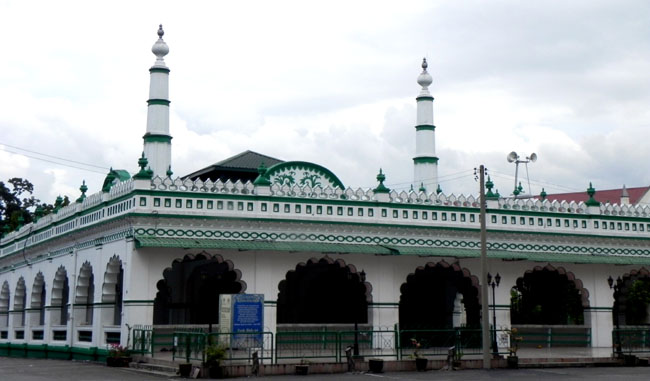
The Kapitan Keling Mosque is a prominent edifice that we can't overlook if we travel around Chulia Street or Cannon Street. It is one of the oldest mosque in Malaysia, which was built in 1801, serves as the place of worship for Indian Muslim for over 200 years, until today. The mosque has very unique domes in black.

We strolled around the heritage area for two days. If you want our overall comment on the heritage site, short and clear- it is rich and full of surprises! Well,  that was not our first time in George Town, yet it has so many new things to offer, which we have overlooked in our previous visits. Now, we can proclaim that we know George Town better, but more yet to be learnt. That's a place that we will revisit again.

What to expect in George Town Heritage Area:
  • Friendly and helpful folks, especially when we need assistance to get the right direction.
  • Trishaw service is available, in case you don't want to labour your feet.
  • Motorbike, bicycle, and car rental services are everywhere.
  • Various Chinese food. Halal food and Nasi Kandar is available in mamak eateries.
  • Street is basically safe, even at night (doesn't mean that we can totally ignore our own safety).
  • Most of the banks and money changers are clustered at Beach Street, Chulia Street, and Little India.
  • Very hot during day time, if it's not raining. A hat or unbrella, enough drinking water, and a comfortable foot wear are crucial to ensure a pleasant trip. We can get an effective map at the airport, and it's free of charge.
Find out more about Penang World Heritage Site at TourismPenang.net, VisitPenang Official Website (very useful. Event calender, food trail, and tour guide are free to download). A brief but very interactive tourism map by PenangTourism.net can be accessed here. A detailed Penang Tourism Map (which we have used all the time during our trip) can be downloaded here. How about the accommodation and food at Penang?

All our sharing on Penang are available at:


Penang Accomodation and Food

Penang is a beautiful island. For those who wish to enjoy the beautiful beach in Penang, we would recommend you all to stay at the hotels at Feringghi Beach. Feringghi Beach is approximately 14 km from George Town. If we take a taxi from the town, it will take around 15 - 20 minutes to reach the beach, and it takes longer by bus.

There are several hotels along Feringghi Beach- Shangri-La Rasa Sayang Resort, Holiday Inn, Parkroyal Hotel, Hard Rock Hotel, and Bayview Beach Hotel. We have stayed in Bayview Beach Hotel. As compared to other major hotels, Bayview has the economic advantage, flat screen, bath tub, room with a lot of space to move around (we stayed in Hillview Deluxe), balcony, etc. Location wise, it is a little bit at the western corner of the tourism belt (which Shangri-La Rasa Sayang located at the eastern corner). Bayview is definitely in our recommendation list for those who wish to enjoy a stay by the beach. You can read more about our experience in Batu Feringghi here.

This is how Bayview Beach Hotel looks like from Feringghi Beach.

We had the opportunity to take a look on the room at Parkroyal. 42' flatscreen, mini bar, well decorated with romantic atmosphere, but it is approximately twice the price of Bayview Beach. Parkroyal is located closer to the tourism hot spot of Feringghi Beach, compared to Bayview Beach. Both hotels are 10 minutes apart, by foot.

Both Parkroyal and Bayview Beach have nice pools. Upper left shows the pool at Parkroyal. There are plenty of space to enjoy sun bath (upper right). Room (lower right) and balcony at Parkroyal look nice.

The website of the hotels at Feringghi Beach are available at:
We stayed at Batu Feringghi for one night, and moved to Chulia Heritage Hotel at George Town. The hotel is small (formerly a mansion). We stayed in a deluxe queen with attached bathroom. The room at the hotel is uncomfortably small, with very limited space to move around. However, it's clean, tidy, with just enough amenity to get a night sleep. Location wise, unbeatable, right in the middle of the heritage site. We came over with some other hotels, which, who knows, might be a good choice as well:
Penang is famous with it's Char Kuey Tiow, fried oyster, rojak, Nasi Kandar (Kandar Rice), and many more, which made our program at night basically, eating all the way down the street.

Penang Char Kuey Teow (upper row) is one of the most favourite food, for both visitors and the locals. It is offered in many food courts. We favoured the char kuey teow at the outdoor food court at Gurney Drive the most. The food court offers nice Penang Rojak (lower right), tau fu fah, fried oyster, and Penang Assam Laksa. For Nasi Kandar (lower left), or the steamed rice with curry and other side dishes,  Restoran Kassim Mustafa at Chulia Street is a good one.

An experienced veteran is one of the guarantees of good taste. The cook told us that they always run out of oyster after 9 pm. So, if you wish to try the fried oyster at Gurney Drive, you better be early.

Crowdy, crowdy, crowdy, are the three words that we would use to describe the food court at Gurney Street. Do you believe that this photo was taken in a midst of downpour?

Wanton (or wonton) noodle (upper left), wanton noodle with soup and beef (upper right), chendol (lower right), and popiah were some other delicacies that we tried in Penang.

We bought food from the hawkers beside the road once in a while. We ordered Penang Char Kuey Teow from this stall at Chulia Street, when we were on our way back to our hotel.

Fresh fruit juice for sale at Chulia Street! We really like the ambra juice from this stall.

Penang is really an excellent island for a break. Beautiful beach, well preserved heritage, friendly locals, and delighting food. We heard a lot about food around Penang, but well, our stomach do have a limit. We would like to save the rest for our next trip. If you wish to share something about food and accomodation in Penang, you are most welcomed to share them in your comments.

All our sharing on Penang are available at:


[Penang Accomodation and Food] [All Our Destinations]

Tuesday, 22 November 2011

Ipoh Old Town

We took a two days trip to Ipoh at the end of October 2011, and we found three interesting things to describe Ipoh- old town, food and limestone caves.

Before we talk about the old town, let's start with our itinerary. Friday evening, we reached Ipoh KTM station (train station) at 9:30 pm,  took our supper at "Tong Sui Kai" (dessert street), and checked into Excelsior Hotel. We went to take "dim sum" early the next morning, followed by taking "yong-liu" (or considered as yong to fu in other places) with Ipoh hor fun (flat rice noodle). We strolled around the old town area for nearly two hours before we took a sumptuous lunch at a local Chinese restaurant on our way to Kek Lok Tong, one of the famous limestone caves in Ipoh. We stopped at Sin Yoon Loong, one of the oldest coffee shop in Ipoh for a sip of original old town coffee in the late afternoon, before we spent our night on a friend's wedding dinner.

Sunday, we tried Ipoh well-known "Nga choi gai" (chicken with bean sprout) and bought some white coffee before we departed home at 2:30 pm.

Ipoh old town is full with hundred years old buildings. Many of them are remained functional until today. Ipoh old town is mainly referred to the town area in between S.P. Seenivasagam Road and Leong Boon Swee Road, on the west bank of Kinta River. Ipoh starts thriving in early 1900, when mining companies were set up at the old town, covering an area around 1000 m x 250 m. Instead of monumental buildings such as the town hall, railway station, the war memorial, St. Micheal Institution, and Birch Memorial which all of them located at the northern part of the old town, the rest of the town is just old two storeys and three storeys shop lots. Starting from the tourist's information center at Tun Sambanthan, we took around 2 hours walking around the area.

Standing at the crossroad between Panglima Bukit Gantang Wahab Road and Dato Maharajalela Road, the town hall of Ipoh is the most prominent edifice that can be seen. Built on 1916, the building was designed based on neo-classical style, similiar to the railway station and the high court of Ipoh. The first political party in Malaya, Malay Nationalist Party held its first congress in this building in late 1945.

This war memorial is located opposite of the town hall, just in front of the railway station (as we can see from this photo). This war memorial was unveiled in 1927, in commemorating the gallant members in World War One. The original plaque was vandalized soon after the installation, and unidentified drug addicts were accused to be the culprits. The replacing plaques that we can see today stated that the memorial is in memory of those who sacrificed during World War I, World War II, during Malayan Emergency (1948-1960), Indonesian Confrontation (1962-1965), Re-Insurgency Period (1972-1990), and those who sacrificed during the construction of Thailand-Burma Death Railway. Only those died in First World War have their names listed on one of the plaques.

Ipoh Railway Station was built in 1917, designed by the same architect who had masterminded the design of Ipoh Town Hall- A. B. Hubback (additional information, he was the one who designed KL Railway Station as well). This building has often been referred as "Taj Mahal of Ipoh".

Along Panglima Bukit Gantang Wahab Road, we saw Ipoh High Court (upper left), built in 1928 and serves as the building of justice until today. Beside the high court stands Royal Ipoh Club (upper left). Established in 1895, the club was the oldest club in Ipoh. St. John Church of Ipoh located at the end of the heritage trail. The church was once the largest church in Malaya. We could only see the backside of the church from the main road (lower left). We have to move ahead and turned into Perak Drive (Persiaran Perak) in order to get into the church's compound.

St. Micheal Secondary School, or formerly known as St. Micheal Institution was founded by Father J. B. Coppin. The school is located at S. P. Seenivasagam Road (formerly Clayton Road). The Gothic style building was built in 1922.

Recently, this historical building was repainted, and its former glory, restored. This school is one of the top rating schools in Perak, in both architectural and performance. The slogan of the school- Quis Ut Deus (Who can compare to God?) and Signum Fidei (A Sign of Faith).

The fine sculptures on the wall of the building can be seen from the main road.

Town Padang Mosque is next to St. Micheal Secondary School. This mosque portrayed special Indian Mogul style, which it's construction was funded by Shaik Adam, a wealthy Tamil Muslim in 1908, with a cost of $500,000. Sheikh Adam Road beside Birch Memorial was named after the Mogul.

Town Padang Mosque is more like a piece of art than a mosque.

We made a right turn after Town Padang Mosque and went down Sultan Yussuf Road (formerly Belfield Street), and we met with this old building of F.M.S. Bar and Restaurant. Some has claimed that it was the oldest restaurant in Malaysia. We were not sure whether the building has been abandoned or, under reconstruction.

Birch Memorial was built in 1909 in memory of J.W.W. Birch. Birch was the first British Resident of Perak, assassinated in Pasir Salak in 1875 by Dato Maharajalela. His death was a lesson to other disrespectful and arrogant British officials. Dato Maharajalela was hanged afterward, but he is sung as a national hero, until today. After the independent, a few roads named after Birch were renamed as Dato Maharajalela Road. The road that next to the Birch Memorial at Ipoh, as you can guess, is Dato Maharajalela Road (ironic, is it?).

HSBC Bank at Sultan Yussuf Road was built in 1931 with neo-renaissance style (upper left). Tenaga National (upper right) and former S.P.H. De Silva building (lower right) were located at the both ends of Maharajalela Road, respectively. Old shoplots like Chung Thye Phin Building are everywhere in Ipoh old town.


Eu Yan Sang is located at Bandar Timah Road (formerly Leech Street, upper left). The shop was found in 1879 by Eu Kong, a tin miner who was selling herbs to cure opium addicts. Then, his son, Eu Tong Sen took over the business and expanded the business into million dollar Chinese pharmaceutical giant, as we can see today. Gabled shophouses (upper right) can be seen at the end of Leech Street. Hawkers are selling their food in front of Sin Yoon Loong (lower right), on the same street with Eu Yan Sang. Famous Ipoh old town white coffee is available at Sin Yoon Loong. Chinese wholesale district is a part of Ipoh old town (lower left).

Most of the shops which are now located in the old town are operated by new owners. Without additional information, there will be no way for us to find out the history of the shops. So, we would like to recommend to get information from Tourist Information Center first before your tour. We found that the leaflets themed "Ipoh Heritage Trail Map 1" and "Ipoh Heritage Trail Map 2" were really helpful for us, in both planning our way through the site, as well as revealing the story behind the buildings.

Our recommended route- Starting from Panglima Bukit Gantang Wahab Road, head north until you reach St. John Church. Then, go back to S.P. Seenevasagam Road. At the end of the road, turn right and walk along Sultan Yussuf Road and its vicinity, until Silang Road. The must visit sites are Ipoh Town Hall, Ipoh Railway Station, St. Micheal Institution, Birch Memorial, the finance street along Sultan Yussuf Road, and the old coffee shops along Bandar Timah Road (at the southern part of Sultan Yussuf Road). The whole journey should take one to two hours (without snack stop).

More information about Ipoh old town is available at:
Perak Heritage Society
Ipoh Heritage Trail Map 1 at Ipohworlds.org
Ipoh Heritage Walk at Malaysia-traveller.com
Kinta Heritage Group Sdn. Bhd. @ Facebook

Instead of the old town area, Ipoh is well known for its food. We tried many of them, and most of them are nice. Follow us to know more about Ipoh's food now.

All our sharing about Ipoh and places in vicinity are available too. Please follow the links below.


Ipoh Food

Ipoh is a city which is famous with its old town, food, and limestone caves. About nice food, plenty of them. We stayed at Ipoh for two days, and it's better for us to share about Ipoh's food chronologically. We started with the supper at "Tong Sui Kai", or the dessert street. Located at Sultan Ekram Road, opposite of Sam Tet Chinese School. The street is around 1.5 km away from Ipoh Railway Station, but it is just 200 m away from the hotel we stayed, Excelsior Hotel.

We tried several types of desserts, such as the shaved ice with fruits, wheat and barley porridge, wantan noodle, Ipoh char kuey teaw, and noodle soup with pork and offal.

A scene at the dessert street. This photo was taken at 10:15 pm, with a large crowd of Ipoh's food lovers gathering at the street. According to Livien (our volunteer tour guide :p), the street is one of the favorable supper site at Ipoh. Most of the stalls there are owned by Chinese. The stalls operate until midnight.

Kelly (LS's sister) with a bowl of shaved ice with mix fruits (upper left) on our way back to our hotel. The shaved ice can be served with many combination of fruits. Ice kacang (upper right) and wheat and barley porridge (lower left) are nice as well, but we like the shaved ice with mix fruits the most.

Chee cheong fun (rice noodle roll), some pronounce as Chu cheong fun at Ipoh has different appearance and taste from other places in Malaysia (upper left). Bee hoon with pork and offal (upper right), char kuey teow (lower left), and wantan noodle were the food that we took at the dessert street.

One of the grandmaster chef of "hum dan" (fried flattened noodle with egg and cockle).

Saturday morning, we woke up early to go for Ipoh dim sum. The shop, Ming Court Hong Kong Dim Sum, located at Leong Sin Nam Road, is just 30 m away from our hotel. 7:30 am, there were not many customers in the shop yet, so there was no problem for us to secure a table. Anyway, more and more customers were coming as the time passed. By the time we left at 8:30 am, it was a full house, with no empty table. Many customers had to wait to be seated. Our advice, if you wish to have a relax environment while you are enjoying your nice dim sum, please be early.

Many types of dim sum are available. For this dim sum shop, we just need to settle down and we will be served. On the other hand, Foh San dim sum shop requires self service.

We reached early around 7:30 am. There were many empty table for us.

This photo was taken at 8:30 am, when we were about to leave Ming Court. The shop was full with customers, with many of them standing, awaiting for empty seats.

Wishing for a enjoyable breakfast and a sense of leisure morning? Then you need to be early. You won't feel good if there is someone standing beside you, awaiting to take your seat, while you are flipping for the headlines after your meal, will you?

On our way to old town area, Livien and Bryant suggested that we make a snack stop at yong tau foo (or yong to fu) shop. The shop, Jia Bing is located at Kampung Paluh area (1.5 km away from the old town area). Although our stomach were really full, still we accepted the suggestion.

Picking the food with a full stomach required more effort than doing the same thing with an empty stomach.

 
Various Ipoh yong tau foo.

Ipoh yong tau foo can be served in soup (left) or to be fried (right). The price, in average, was RM 0.70 per item.

Original Ipoh old town white coffee comes from Sin Yoon Loong at Bandar Timah Road (formerly Leech Street). The shop was established in 1937. For the past 70 years, it served Ipoh with its famous white coffee. Today, it remains as an old coffee house, serving nostalgic white coffee, brewed from freshly roasted coffee bean.

Can you imagine how good is the coffee here? The customers keep on coming, even though it was almost 5 pm.

After being standing and waiting for 10 minutes, we found a place to sit. The taste of the original Ipoh white coffee didn't let us down. Not sort of legendary taste, but, with RM1.30 per cup, it definitely beats Starbucks coffee in many ways.

Ipoh bean sprout chicken. Somebody told us that, if we ever missed Ipoh bean sprout chicken in our  trip, then we couldn't be considered had ever visited Ipoh. That was serious. So, to conclude our Ipoh trip, we visited Onn Kee Restaurant, one of the best bean sprout chicken shop in the town. Onn Kee Restaurant is located at Yao Tet Sin Road (in Google Map is Yao Tet Shin). Another famous Ipoh bean sprout chicken shop, Lou Wong is just beside Onn Kee. Again, we would like to mention that it is just a few hundred meters away from our hotel.

Onn Kee Restaurant is located side by side with Lou Wong. Both restaurants. No matter they are friends or enemies, both of them serve delicious bean sprout chicken (we tried Lou Wong before, on our previous trip to Ipoh).

Mouth watering kampung chicken (upper left) served with Ipoh home grown bean sprouts (upper right). According to the locals, the bean sprouts are grown using natural mineral water from the limestone hills in the vicinity of Ipoh. So, the taste is better than the ordinary tap water grown bean sprouts. The portion served was more substantial compared to Hainan chicken rice at Melaka. One whole kampung chicken was enough for 7 persons. The price, together with all other dishes (lower right) was about RM10 per person. Instead of chicken rice, we can choose to have Ipoh hor fun together with the bean sprout chicken.

Lunch with Bryant, Livien, Livien's parents, and Kelly (cameraman).

Lastly, tau foo fah at Ipoh. Tau foo fah (or to fu fah, or to fu fa) is a traditional Chinese food made by soy bean serves in sweetened syrup. We tried Ipoh tau foo fah at two different shops, one is Funny Mountain at Theatre Road, which is a block away from Lou Wong and Onn Kee, another is Woong Kee at Dato Onn Jaafar Road. 

The nice food in Ipoh are quite scattered. However, we are lucky as we stayed in Excelsior Hotel. Tong Sui Kai, bean sprout chicken, Ipoh dim sum, and some tau foo fah shops are within walking distance from our hotel. So, if you wish to try some nice Ipoh's food, you can consider to stay in Excelsior Hotel, or somewhere nearby. 

To all our readers, if you have some recommendation about nice food in Ipoh, please share it in your comment. A big thank you to all of you.

Now, let us go to visit some Limestone Caves in Ipoh.

All our sharing about Ipoh and places in vicinity are available too. Just follow the links below.