http://www.bestphoneapps.mobi/?sl=213796-741ac&data1=Track1&data2=Track2
Showing posts with label Sabah. Show all posts

Monday, 4 January 2016

Places to Visit for One Day Trip in Kota Kinabalu, Sabah

Kota Kinabalu has become an international hub, where people around the world make it a transit in their way in and out of Malaysia. Approximately 8 km from the city airport, Kota Kinabalu is just steps away from the terminal building. Well, if you have made Kota Kinabalu your transit in your upcoming tour, you might wish to take a one-day stop there. We visit Kota Kinabalu at least once a year, and this is our must visit list in Kota Kinabalu to fill your one-day itinerary. 


Lok Kawi Wildlife Park
25 km away from city center, it is one of the most well-managed wildlife park in Malaysia, with a list of Borneo pygmy elephants, orang utans, sun bears, gibbons, Proboscis, hornbills, and many more. It is the best place to see these indigenous animals without travel days into the jungle or cruising down the river. The park opens daily 9:30 am – 5:30 pm. For Mykad owner, the entrance fee is just RM10 for adult and RM5 for kid. The entrance fee doubles for the visitors without Mykad. A round trip should take not more than 2 hours. The animal shows are at 11 am and 3:15 pm.

Although bus services are available from Menggatal and Likas, taking a taxi is the best way to reach the park. Getting there by a rented car is a good idea as well. The taxi fare should be around RM60 – RM100 (two ways), while a rental car is available in airport with around RM130 per day. The journey will take 20 – 30 minutes with car.  More information about the park is available at our Lok Kawi Wildlife Park post.

Entrance of the wildlife park.

Animals are well-kept. We have been to the park for several times. The animals were active most of the time.

Sabah Museum
Although it is not as spectacular as Sarawak Museum, but it is still a well-organized museum. With it recent facelift, the full air-conditioned exhibition halls promise comfortable environment to the visitors. The main attraction of the museum is the skeleton of 22m-long Bryde’s whale. We found the Nature Gallery, the Sabah Cultural Gallery, and the Archaeology Gallery were indeed very interesting. The photo gallery is quite informative as well. Anyway, it is just a small museum, so we could see everything in less than 2 hours. The entrance fee for Mykad owner is RM2 while RM15 is required for those without Mykad.

Well, the museum can be easily accessed by taxi (fare around RM10 per trip) or by bus. We would recommend to visit the museum before or after visiting Lok Kawi Wildlife Park, as both are located on the same direction from the city. More information about the museum is available at its official website.

Next on our list, Simply Chocolate factory.

The outlook of the museum. Photography is prohibited inside of the museum.

Simply Chocolate Factory, Jalan Muntahan
It is small, simple, and it is a place that you may wish to visit to grab some local souvenir for your friends and family. The small factory is located at Lorong Muntahan (by Jalan Penampang), in between Sabah Museum and Lok Kawi Wildlife Park. 

By the way, we can get Simply Chocolate in other bigger and more appealing outlets, so why this one? Well, in this particular factory, we can get the same quality chocolate with much cheaper price. So, why not. Not convincing? Just walk around the souvenir shops around the airport, museum, and down the city and compare the prices.

The chocolate factory is facing inside and it is not easy to be seen from the Muntahan main road (upper left). Some of the chocolates packaged for sell (upper and lower right), and samples for us to taste before we decide what to buy.

Tanjung Aru
It is indeed one of the most famous beach in the world. The beach is quiet in the daytime, and turns happening at night. The best part of it- watching the sun sinking below the horizon accompanies with the disappearance of the islands in the soft blowing breeze. The sea is always calm and the water is always clear, but the beach is not always as clean as it shown in luring photos, and beware, your luck plays important role to witness the stunning sunset, so do pray hard for it.

For us, watching the sunset is always the main agenda. The food and drinks (hawker center and the pub) are not in favour of our taste, except for the coconut water in the hawker center. Although the sunset is free, but not for some parking lots. If you are driving and reluctant to pay, then you may need to park your car further down the road, some 400 – 500 m away from the hawker center (nearer to the Shangri-La Hotel) to avoid blocking the traffic.


Tanjung Aru Beach is quiet during the day time.

The observation post of Shangri-La Hotel at the beach.

Sunset at Tanjung Aru.

Seafood Dinner
We would recommend two new places for seafood dinner. The Catch Seafood Restaurant and Grill. With a price of RM45 for adult and RM22 for kid, the restaurant provides seafood buffet with various choices including fish, clams and shells, prawn, and crab. The cooks are ready to prepare the seafood for us according to our choice. In addition to that, free flow of grilled mutton, beef, noodle, spaghetti and many other dishes are available as well. It is located nearby Merdeka Supermarket by Jalan Penampang. The signage of the restaurant can be clearly seen from Jalan Penampang. With very good service and clean environment, it is a great place for a sumptuous seafood dinner. More information about the restaurant can be found in its official website.

Wish to get some seafood inside the city? Then Welcome Seafood Restaurant can be a good choice. Located at the ground floor of Asia City commercial building, the Chinese restaurant can be reached by foot within city area. The restaurant offers nice seafood with fair price. Full air conditioned section is prepared for us to escape the hot and humid weather. Nothing is perfect. The service of the staff is not up to the standard. However, for us, we don’t really mind to be annoyed a little bit to get good and cheap seafood.

The Catch Restaurant and Grill at night.

The restaurant is clean (upper left). The cooking service is provided free of charge. So what we need to do is choosing our favourite seafood and the way to cook it (upper and lower right). RM45 is a bit expensive, but can you imagine that we can eat seafood with different ways of cooking to your heart content?

Last Minute Shopping
It is huge, it is new, it is Imago Shopping Mall. Indisputable, Imago provides the best shopping environment, but it is a bit far away at the corner of the city. If you are hunting for original Tenom Coffee, souvenirs like shirt, hat, and key chain, local delicacies or indulge yourself with a sip of Starbuck coffee, then Centre Point is still the best in our list. What, that old shopping mall? Yes, if you wish to get something fast, convenient, and with fair price, it is still a good place to go. By the way, the shopping mall is just a few minutes away from Welcome Seafood Restaurant. Seashore with stunning view is just few steps away as well. A few other shopping malls like Asia City, Oceanus, and Warisan Square are close to Centre Point as well. 

Centre Point at night.

The Gaya Market is held on every Sunday, starting as early as 5:30 am till noon. It is a great place for us to get exposed to various local products. However, we need to make sure that our stopover includes Sunday morning. Kota Kinabalu shopping guide is available here.

Market at Gaya Street with various local products.

Places to Stay and More
Where to stay in Kota Kinabalu? Our advice is, stay as close as possible to the city area, and stay as cheap as possible. There are many good budget hotels scattering around the city, and we have highlighted several of them for you here. Please check the most recent comments about the hotels in Tripadvisor.
There are many other attractions around Kota Kinabalu. If you have one more day to stay, we would recommend Tungku Abdul Rahman Marine Park to you, and if you plan to stay a bit longer, you might wish to visit Kinabalu National Park, or go rafting at Tamparuli. 

More about our experiences in Sabah:


Tuesday, 22 September 2015

First Malaysia Homestay Experience at Kota Belud

We travelled 70 kms northeast from Kota Kinabalu, the capital of Sabah to Kota Belud, then another 16 kms from Kota Belud to Taginambur, a settlement at the foot of Mount Kinabalu. We left our car at Taginambur and hopped onto a 4WD prepared by Mr. Sarun. It was another 20 minutes bumping on mud infested gravel road before we stopped at the rest point of Wasai Waterfall. Sarun, our driver, tourguide, and also the owner of Nopungguk Homestay led us through another 200 meters of muddy path downhill to reach the swimming area of the waterfall. The surrounding was green, the air was cold and dense. We were back to nature in our first homestay trip.

Located in between Kampung Gansurai, Kampung Tinata, and Kampung Podos, Nopungguk Homestay takes the name of nearby Nopungguk Hill. Sarun, a local teacher, started the homestay as a community project. The homestay currently consists of 10 local houses scatter around the peaceful villages far away from city. Surround by nature beauty patched by local orchards, it is a great place to experience the village life in the heart of Borneo Island.

To enjoy the village life in a relaxing way, Sarun had personalized our itinerary- Wasai Waterfall, fruit buffet, and dinner for the first day (we arrived in the afternoon). For the second day, we had fish spa at 'tagal' area after our breakfast, durian hunting, and shopping for local souvenir. We went back to Kota Kinabalu at around 2:30 pm after our lunch.

The gravel road connects the villages to the outside world (upper left). "Selamat Datang" or "Welcome" to the waterfall of Podos Village marks the point where we need to stop our car and continue our journey by foot (upper left). Bamboo handrail is really helpful when we walk through a 45 degree slope (lower right). After 15 minutes of adventurous jungle walk, we finally reached the beautiful waterfall in the middle of jungle. 

The deepest part of the pool was about 5 feet. The water is clean and clear. We were surprised that the place was actually free of mosquito.

 The waterfall is around 60 m high, pouring down natural cold water from the hill.

One of the villagers gave us two tarap (a kind of local fruit) on our way down to waterfall. So we decided to make them our afternoon snack.

The flowing stream cutting through the natural jungle, while forming bathing areas with cold crystal clear water. Bathrooms are prepared at the waterfall area. However, we decided to take bath at our homestay, which was 20 minutes away from the waterfall.

Nice green view along the hilly road.

The homestay is 20 minutes away from Wasai Waterfall (upper left), ready with a living area (upper right), three rooms (lower right), and a kitchen.

 The balcony of the homestay is a great place to have our afternoon tea.

Electronic keyboard was never in our expectation list for a homestay (upper left). So, we decided to make good use of it. The photo of the activities, certificates (upper right) and decorations (lower right) in the homestay. Free flow drinks and beverages are prepared for us.

Meals were nicely prepared by Sarun's family. Besides some common Malaysian dishes, we were served with traditional food like tuhau (Coccinea)- a kind of ginger herb found only in Borneo (lower right). We were provided with one dinner, one breakfast, one lunch, free flow of local fruits, and different types of beverages in our trip.

What did we have in our "local fruit buffet" at Sarun's house? Durian (upper right), rambutan (lower left), and manggis were some of them. We were lucky, it was the season for the fruits.

Our first day programs started at Wasai Waterfall, followed by a "local fruit buffet", and ended with our dinner. Second day, we woke up early for another day packed with fish spa at Kampung Melangkap Tiong, durian hunting, and shopping for local handicrafts. 

Kampung Melangkap Tiong was our third 'tagal' area visited in Sabah, where the environment around the 'tagal' river was protected by local laws. Compared to the tagal area at Luanti Baru, the fish at Kampung Melangkap Tiong  provided a better spa service to the visitor. They were more gentle, plus, the stones were arranged along the river allowed the visitors to sit comfortably while dipping their feet into the stream. The fee was very cheap- RM3 for adult and RM1 for child for every 30 minutes! Fish food was sold with RM1 per package. The entrance fee and the fish food were included in our homestay package.

Mount Kinabalu can be seen on our way to 'tagal' area at Kampung Melangkap Tiong.

The entrance to the 'tagal' area is marked by a wooden hut (upper left). The area was quiet in the morning (upper right). Stones are well arranged along the river so the visitors can have a nice place to sit and enjoy the spa (lower right). We spent one hour to enjoy the fish spa before we moved on for our durian hunting.

Searching for durian in the orchard was a new experience for us (upper left). Guided by Sarun, we were lucky to get some durian freshly dropped from the tree (upper right). Then, we decided to eat the fruits fresh on the spot (lower right). Beside durian tree, we found other fruit trees around the area as well.

Shopping from house to house along the kampung road was another new experience for us. The rattan-ware is produced as cottage industry, thus different family produces different types of rattan-ware with their unique designs. The price, much cheaper than we could get from the market. After lunch, we continued to visit several more houses for rattan baskets before we departed back to Taginambur.

Our photo with Sarun's family.

Nopungguk Homestay is a relatively new community homestay in Sabah. It offers various local activities, such as traditional dance, music, handicraft making, rice production, rubber tapping, fish spa, river bathing, fish trapping, Rafflesia hunting, fruit picking, jungle tracking, and mountain climbing for the visitors to experience with. Good experience for us? Definitely. The homestay has successfully provided an excellent blend into the village's life. More information about the homestay is available at Nopungguk Homestay Blogspot. 

Other experiences in Sabah are available at:

Friday, 21 February 2014

First Rafting Experience at Kiulu River, Sabah

Rafting was never in our to-do-list, ever, until our sister Jenny recommended it to us. She said that it was fun and full with excitement. Since we never step our foot on a raft before and we just needed to pay RM50 per person, with lunch included, so why not take a try? 

Kiulu River is around 45 km from Kota Kinabalu. It can be accessed through the nearest village, Tamparuli, on the way from Kota Kinabalu to Mount Kinabalu National Park. From KK, we drove 1 hour and 15 minutes to the rafting company, and then, the company staff brought us to the starting point, which was another 15 minutes upstream. 

From our experience, the place was not easy to reach even with GPS, unless you know the place really well. Following a tour or rafting company from KK or Tamparuli should be the better choice for tourists. However, if you don't mind to drive, please make sure you bring a most up-to-date map or GPS, and of course, with the reservation done earlier.

For us, we did our reservation few months earlier with Poturidong Tengah Bundu Camping Site. The general manager Alson Kangit (013-8145668; alson_kangit@yahoo.com) was working in medical field before he gave up his job in the hospital and embraced one of his hobbies- rafting. The price offered by him was unbeatable- RM 40 per person for rafting, and RM 10 per person for lunch at the camping site, and RM 50 for one CD containing professional photos taken by Alson himself. By the way, Jenny had joined a few rafting activities with the company before. The whole rafting took us 1 hour 45 minutes. We were served with simple but delicious buffet lunch after that.

Rafting means we have to deal with water, rapid, stones, and a lot of sunlight. Water resistant sun block is a must or else, will be roasted by merciless sun. Safety gadgets such as life jacket and helmet are required as well, and provided by the rafting company without extra charge. We were briefed by our guide on how to paddle, stabilize ourselves, some simple commands, and general safety precaution before we dipped our feet into the freezing cold water.

Well, the journey started in relax and calm.

Then, with challenges ahead.

Paddles were uplifted when we rafting down the rapid to avoid hitting the stones, while enjoying the fast and furious.

Getting wet was inevitable, especially when we cruised down the rocky rapid.

Took a break when the river turned less rocky.

When we reached the slow flowing stretch of river, we need to start paddling to keep moving.

We were not alone. We were greeted by several other groups when we headed downstream. Splashing the cold water with our paddles to other raft was another way to say "hello".

Poturidong Tengah Bundu Camping Site provided a good service to us, with relatively low price. The guide was very informative and helpful. With his encouragement, we experienced swimming in Kiulu river, body rafting, slamming the rock with the raft, and capsizing the raft. He shared his experience and his life as a villager living along the river as well. The lunch contained three main dishes- curry chicken, fried fish, and stir fried vegetable, with rice and beverage. It was simple but enough to refill our energy.

This is the camping site where visitors could stay with RM10 per night, with only accommodation provided.

The road lead to Kiulu was small (upper left), the dining hall with strong village-feel (upper right). The entrance of the camping site was marked by the white house (lower left). One thing that we wished to comment- the toilets and the bathrooms were a bit too simple.

Rafting was a great experience, especially when it came with low prices. For those who wish to raft around but unwilling to spend big money on it (like us), then Kiulu River might be a place for you. By the way, Kiulu River only good enough to provide grade 1 and 2 of challenge. Grade 3 and 4 are available at Beaufort.

In case you are curious like us about the usage of  "whitewater" in rafting, whitewater in fact refers to the rapid flowing water which is disturbed to form white colour.  There are 6 grades in rafting, which grade 5 is very risky and 6 is illegal in some places.

For more about our sharing Sabah, please read our previous posts:


Tuesday, 20 August 2013

The Kinabalu National Park - Page 2

Celyn Hotel was located high on the top of a hill far from the main road. The branch road lead to the hotel was too small and too steep for our bus. So, we could only reach the hotel by another 10 minutes' trip using smaller and lighter transit van prepared by the hotel.

Our trip to the hotel was turned into 40 minutes of waiting as the hotel could only provide only one small transit van for us. The van took 3 turns before we were brought to the hotel. Celyn Hotel was a terrible choice for those came in a big group with big bulky bus. The slow transit from the main road to the hotel diminished the good holiday mood.

Small, steep, and winding Semuruh Kinondusun Road lead to Celyn Hotel (upper left). The hotel provides small transit van for those who comes in big bulky bus (upper left). We couldn't leave our luggage unattended (lower right). So, the scenario which people went first and luggage followed later was out.

The room for double with mountain view (upper left). The family suite that we stayed (upper right and lower right) was completed with second floor. The path led to our room was built without cover. It would be very inconvenient to access to the room in rain.

 Good highland view is the only good thing that Celyn Hotel could offer.

Mount Kinabalu couldn't be seen during our stay. The peak was covered by the clouds.

Second day, we departed from the hotel early at 7:30 am to Poring Hot Spring at the foot of the mountain. Poring means bamboo in local. The bus took around 30 minutes to travel from our hotel to the hot spring.

As a part of the heritage site, the conservation fee was required. For MyKad holders, the fees were RM 3 for adult, RM 1 for kid and senior citizen, and free for those below 6 years old. Without MyKad, the fees were RM 15 for adult, RM 10 for kid and senior citizen, and again, it is free for those below 6 years old.

In fact, the whole area around Poring Hot Spring is big with many attractions. We can spend a full day, discovering not only the hot spring, but the butterfly farm, the canopy walk, and Kipungit and Langanan waterfalls as well. However, due to time constraint (as arranged by the tour company), we stayed there for only an hour. What a waste. We will definitely come and stay for longer time in future. By the way, Poring Hot Spring is a must visit site in the national park.

The road lead to Poring Hot Spring was well-maintained (upper left). Floats and tubes were sold at shops opposite of the hot spring (upper right). A bridge (lower right) was built to connect the entrance (lower left) to the bathing area.

The bathing area of Poring Hot Spring (upper left). Rock pool beside the bathing area offered super cooling water from the highlands (upper right). The water from the hot spring was channelled to the public bathing tubs where visitors could enjoy the warm water.

We have only one hour to spare at the hot spring, so we decided to get our feet dipped. Together with us was our tour guide Catherine.

The source of the hot spring. The water gushed out within the stones.

As the hot spring has been named Poring, then the site should has some bamboo trees. Yes, we could see some very old bamboo trees somewhere near the bridge.

Then, we went back to Ranau, where we visited Kampung Luanti Baru. The village is a part of the river conservation programme where "Tagal" is practiced. Tagal is a traditional Kadazan Dusun practice to ensure the sustainable production of the river, which the fish can only be caught during certain seasons. The catch then will be distributed among the villagers. Tagal means no fishing in local dialect.

In Luanti Baru, Tagal had turned the polluted river into natural attraction where the Pelian fish were trained to provide natural fish spa to the visitors. That should be the biggest natural fish massage pool in the world. What we need to do is, dipping our feet into the river, and the tame fish will come and bite our feet.

Painful? A bit. The fishes were too big for a gentle foot massage. We personally don't believe about the treatment or health value of fish spa, however, that was the once in a lifetime experience. The fish spa opens daily from 8:30 am - 5 pm. The fees for 15 minutes of spa, for MyKad holders- RM 5 for adult and RM 2 for kid. For those without MyKad, the fee is RM 10 per person.

More information about this huge fish spa river can be found at SabahTourism.com website.

The entrance of the natural fish spa was marked by a giant fish (upper left). A few stalls were set to sell drinks and snacks along the way to the river (upper right). The food and drink were sold with reasonable prices. We had to register at the counter by the river before we could walk into the river (lower right). The guard at the counter was the time keeper as well. Some facilities at the site were built by bamboo.

The members of our group at the river.

We had to use fish food to lure the fish to our feet. The fish food was sold separately from the registration counter with cheap price.

From Luanti Baru Village, we travelled back to Ranau for lunch at Restaurant Double Luck at 11:45 am. The food, fair taste with fair price. As our tour members were scheduled to fly back to Sibu at 7:30 pm, we headed back to Kota Kinabalu airport right after the lunch.

Ranau is the biggest town between Tuaran and Sandakan, with at least a few grocery shops, a supermarket (Milimewa), a few banks, and of course, many eateries. It is close to many attractions as well. To our surprise, we didn't see many hotels within the town area. In our opinion, more hotels should be set up at Ranau for its convenience and strategic location. By the way, Ranau means flat land in local.

Street of Ranau.

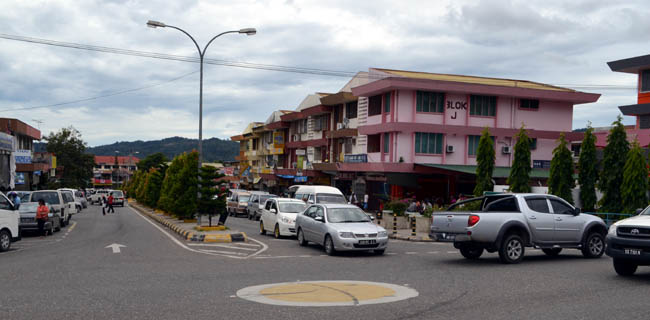
Many shops are operational at the fourth day of Hari Raya Aidilfitri. The streets were full with people and cars.

Wild boar meat is available. Our lunch with four dishes- stir fried wild boar meat with onion and ginger, steamed chicken, and two vegetables cost around RM 12 per person, including drinks.

We stopped by Kundasang market on our way back to Kota Kinabalu for last minute shopping. Local fruits and vegetables were sold with remarkable cheap price. The market is located along the main road. It always causes traffic jam for the double parking and slow moving vehicles.

Various types of vegetables, fruits, flowers, and other products from the highlands were sold in Kundasang Market. This market could be easily identified as a belt of single storey wooden structure by the main road.

Various types of honey (upper left), super hot yellow chili (upper right), and highlands rice were something that we found interesting. Flowers were available too.

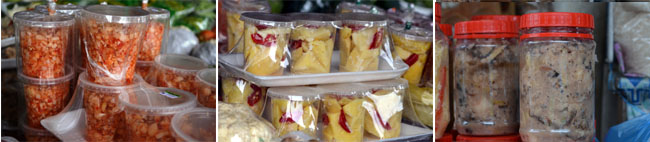
Ha, try if you dare! Left photo shows Tuhao- a mixture of wild ginger and chilli, pickled in salt and vinegar. Jeruk Bambangan is showed at the middle- wild mango preserved with chili and salt. The right is a mixture of Kepayang fermented with raw fish, rice and chili. All these authentic Sabah food can be found in the markets at Kundasang and Pekan Nabalu. You can find more information about these only-at-Sabah Food here with recipe. Photo of Bambangan is available here.

Flowers and other highlands plants were sold in the nursery.

Overall, our two days' trip was concluded as "too rushy". Kinabalu Park deserves more exploration, even for someone who has no intention to go above 4000 meters. The public transportation in the park was next to zero. The taxi was the second best option, if you don't dare to drive by yourself (a rental car from KK Airport is from RM 160 a day, you can get even better deal at KK town). 

"Minibus" operated by the local individuals basically helped a bit to bring tourists from a place to another. However, the operation goes without fixed schedule, and the fare was determined according to the number of passengers (the more the cheaper). According to our tour guide, the fee for the minibus from Kinabalu Park Headquarters to KK city was around RM 17 - RM 20 per person if the bus was fully loaded.

About the food, according to our observation, many restaurants were attached to the hotels, and the hotels were far from each other. Dine in your hotel might be the only option that you have without own transport. Basically, the food that we had were quite nice, except the steamboat dinner that we had at Celyn Hotel. The steamboat dinner was too expensive and not worth the money paid- RM 38 for a dinner full of noodles and fish balls (and other types of processed food).

As we were much adapted to free-and-easy and back pack style of travelling, we were not used to the itinerary arranged by the tourism company. However, we had to take it, or leave it. Of course, next time, we will drive. 

Kinabalu National Park is the place we will definitely go back for more exploration. We would like to take our opportunity to thank our freelance tour guide, Miss Catherine for her dedicated assistance, and Borneo Legend for arranging the bus for us. Catherine can be reached at cathtyy@gmail.com.

For more information about Kinabalu National Park, you can visit SabahTourism.com,Sabahparks.org, and ClimbKinabalu.com. 


[Back to Page 1][Page 2]