http://www.bestphoneapps.mobi/?sl=213796-741ac&data1=Track1&data2=Track2
Showing posts with label Travel Article. Show all posts

Wednesday, 2 July 2014

Great experience in KLIA2

Is it a shopping center, or an airport? Well, KLIA2 is both. It was an exciting moment when we firstly stepped into the new KLIA 2. First minute impression- it was huge! In the next 5 minutes, we discovered that it was clean, organized, and friendly to visitors.

KLIA2 no doubt is a great leap from old and small KLLCCT, which you might not even want to stay there for extra 30 minutes. The new airport houses a two-and-a-half-storey shopping mall, which will keep visitors busy for a few hours. Most of the tenants are food and beverages providers- McDonalds, KFC, Texas Chicken, Starbucks, Burger King, Baskin Robbins, Boost, Old Town White Coffee, Nando's, Kenny Roger Roasters and many more. They are the professionals in keeping the visitors well fed. How about last minute shopping? Well, just walk around the airport and you will find F.O.S., PoloHaus, Voir Gallery, Giordano, Euphoria, Skin Food, City Chain, The Body Shop, Carlo Rino, Beryl's and many more scatter within the complex. Bored by clothes, cosmetics, chocolates, or watches? Why not try to bring back some surprises, such as local food? Well, you might find some out of the box souvenirs at Jaya Grocer. We found that the price for the food and beverages offered by the fast food chains were reasonable.

The airport complex has five levels. Level 1 (L1) is the bus and taxi stations, providing free shutter service from KLIA2 to KLIA. The ticket counters are located at that level as well. Level 1M (L1M) connects to Tune Hotel which is located about 150 meters away via covered walkway. Level L2 (L2) is connected to arrival hall, ERL Station, and multi-storey car park. Level 2M (L2M) is designated for eateries, and Level 3 (L3) is connected to departure hall.

So far, we used only ERL to go to KLIA2 because it was very convenient. We parked our car at Putrajaya Central, hooped into train, and we were in KLIA2 in less than 30 minutes. The parking fee at Putrajaya Central was cheap- RM 5 per day, much cheaper than the parking fee in KLIA2.

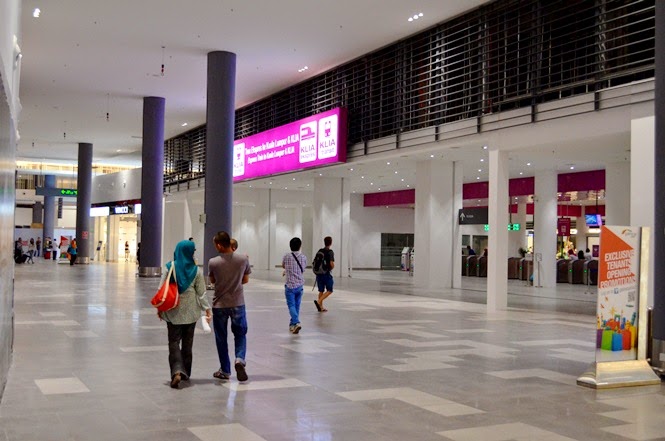
A snapshot of shopping complex at L2 (upper and lower left), L2M (upper right), and L3. L2 is connected to arrival hall, while L3 is connected to departure hall.

  Spacious walkway, prepared to accommodate massive number of visitors.

KLIA transit and express (ERL) is located at L2, same level with the arrival hall. Ticket price from KLIA2 to KLIA was RM 2. However, the trip was free on shuttle bus available at L1. ERL schedule can be obtained from its official website, and you can find the fares and passes too.

Signs are strategically placed (upper left). Counters for bus and taxi tickets are located at L1 (upper right). L1M is connected to Tune Hotel with covered walkway (lower right). Many people were waiting for their friends and family outside. Maybe, they haven't discover that there is a shopping mall inside. By the way, the information about fares for taxi is available at KLIA.info.

The signage with direction and estimated time to reach by foot.

 The departure hall is many times larger than its predecessor, KLLCCT.

 The walkway to the boarding gates is complemented with one-way travelator.

The boarding hall is filled with shops (upper left). One thing that we wish to complain- the slope on our way to J-gates is not friendly to visitors, especially when we need to do the CLIMBING after long, exhauted flight, on our way from the gate to the main building (upper right). The baggage reclaim hall is quite narrow (upper left), but the system is good by stating the estimated time for the first bag to arrive.

The arrival hall is behind this up scaling slope.

We read from one article which criticized the lack of identity for the airport. It stated that the gateway to Malaysia was focused too much on shopping and eating. Well, our opinion, comfort and convenience are the top elements for a world class airport. KLIA2 has them both. Well, the new airport is completed and officially opened. It is now in the hand of the management to keep it as a world class airport. Maintaining it at its top condition is always more challenging than building it.

Our travel articles:

Thursday, 8 May 2014

Farewell Kuala Lumpur Low Cost Carrier Terminal (KL LCCT)

It was a place full with our memories. We lost our counting on how many time that we had actually visited KL LCCT. We can't even remember when was our first visit to the terminal. But for sure, we had used the terminal for our trips to Sibu and Kota Kinabalu for quite a number of times. Other places, Kuching, Bintulu, Penang, Kuala Terengganu, Bangkok, Bali, Siem Reap, Singapore, Phnom Penh, Hanoi, Yangoon, and many more. In fact, Some Story about Us is so closely knitted with this small terminal in the middle of South East Asia. 

Since the opening in 2006, the terminal had served as the "Air Asia terminal". Once Air Asia moves to new terminal at KLIA 2 on 9 May 2014, that's the time for air travellers like us to say bye-bye to the old terminal. We would like to share some photos that we took in KL LCCT with all of you. Phuket was the last destination for us from the terminal. Then, Sibu will be the first for us from KLIA 2.

The wall of the terminal was built mostly by metal. The entrance to the domestic flights was busy all the time.

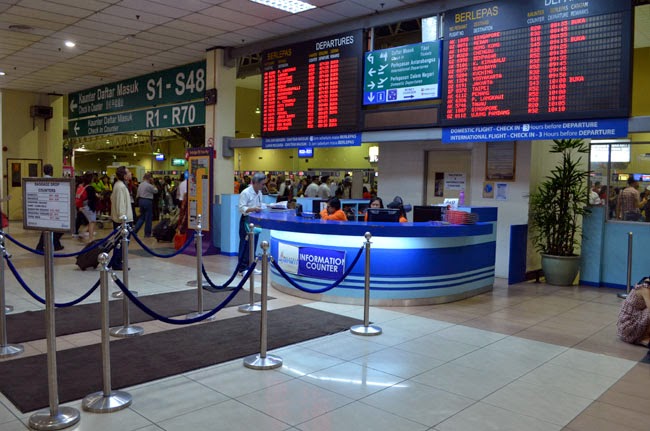
The information counters. The check-in counters can be seen far at the middle of this photo, behind the information counter.

This is the waiting area for domestic arrival, stuffy and always filled with the smell of the smokes from vehicles.

The narrow walkway connecting the domestic arrival hall with other parts of the terminal. This walkway was always jammed with many people. We used to buy newspaper from the bookshop and read it in McDonald's while waiting for our flight.

The entrance to reach the international departure check-in counters was located on the left side of McDonald's restaurant.

The international departure hall (upper row). These photos were taken just before our flight to Phuket, Thailand. We took the photos of international arrival exits on our way back (lower row).
Hot & Roll was our favourite stall in the international departure hall. The food was tasty and cheap, good for breakfast and snack. This photo was taken in 2013.

Taste of Asia was famous with the exquisite and expensive local dishes (upper left), while Coffee Bean and Dunkin' Donuts served western food. Well, the eatery that we visited frequently- Chocolate. We visited Chocolate for the last time on our way to Phuket and took our change to bid farewell to the staff.

The budget taxi bay just outside of the arrival hall.

Well, our last trip from LCCT to ERL station. Interestingly, the bus company referred LCCT as Air Asia. Anyway, starting on our next trip, we don't have to use the bus service anymore. We can go to Putrajaya Central directly using the ERL service.


GOOD BYE KL LCCT. 


Want to read more about other attractions in Kuala Lumpur? Please visit:


Tuesday, 6 August 2013

Getting Around Bagan

Taking Flight to Bagan
The most concerning question about Bagan- how to get there? Flying within Myanmar is expensive. We tried to be early in booking the ticket. We contacted our hotel manager in Yangon a month before our departure from Malaysia. We got a simple reply by email- they would handle the tickets for us.

Without being asked for the information such as our full names, nationality, passport number, etc. we had wondered how exactly they could "handle" our booking.

Not to our surprise, our tickets were not ready upon our arrival at Yangon. The manager told us that in Myanmar, it was "normal" to book the flight ticket a day before the departure. Well, that's what we learnt in Myanmar.

As the tickets were not ready, we decided to scout for several airline agents in Yangon for the best deal- Air KBZ, with the price USD110 per person per trip was what we got. The fare was expensive compared to the domestic flights in Malaysia. However, that's the best deal we could get.

We found that the domestic airport in Yangon was really modest. Of course, we found out later that Bagan Airport was even worse. However, to our relieve, the aeroplanes used by KBZ Airline were in good condition, with remarkable good service.

The departure hall of the Yangon Domestic Airport is small, with a few stalls selling local souvenirs (upper left). Check in counters (upper right) with the eye-catching red analog weights (lower right) in the airport. These nostalgic analog weights has gone extinct in our country 20 years ago. The departure hall was quite crowdy when we were waiting for our flight.

The inflight service was better than what we had expected. The air cabin was clean and tidy (upper left). The food was served together with wet tower.

Bagan Airport was small. The building was well maintained from the outside (upper row). However, the arrival hall and baggage reclaim room were basically in a same small room (lower left). The waiting area, check in counter, toilets, money changer, airline representatives, souvenir shops, a small cafe, and everything else were located in a same area (lower right). The counter selling admission ticket to Bagan Archaeological Park can be seen on the right of the photo.

People
Most of people in Bagan couldn't understand English, except for those who work in tourism and related industries. They were friendly, as when we greeted them, they replied in a polite way. A few young monks asked us for "donation" at Shwezigon, while several vendors approached us to sell their products. We could easily turned them away through a soft and polite refusal.

One of the vendors that we met at Thatbyinnyu asked us many things about our country. He had friends working in Malaysia. Our first night at Bagan, we found two villagers singing and playing guitar ouside of our eatery. They were happy enough to take photo with us. Then, our hotel's manager talked to us regarding the education and future of kids in Bagan. We enjoyed talking to these friendly people.

Currency and Exchange
Money changing was available in Nyaung U. USD 1 to 930 Kyat at KBZ Bank. That was the best deal we had in Myanmar. Hawkers and vendors by the road offered money changing as well, with one problem- terrible rate.

In Bagan, Kyat was more convenient to be used than US Dollar. In fact, we used Kyat all the time in Bagan. US Dollar was used only for entrance fees (USD10 for Bagan Archaeological Park and USD5 for the museum).

Place to Stay
We stayed in Thiri Marlar Hotel in New Bagan. New Bagan is around 8 km south of Nyaung U. Most of the hotels are available in New Bagan and Nyaung U. Nyaung U is a small town, while New Bagan is like a small village. Thiri Marlar Hotel was located at Thiri Marlar Street at New Bagan.

Thiri Marlar Hotel was a good hotel. Ranked high in Tripadvisor, the hotel provided good services with just USD45 per night for a double room. Well, it worth every single cent that we had paid. The breakfast on the roof level of the hotel was an amazing experience- looking over the old temple structures while enjoying our breakfast. The room came with water heater in the bathroom, air conditioner, nice bed, mini bar and wooden floor. The room service was punctual and satisfying as well.

The down side, there were no water boiler and coffee making facilities (maybe the tap water was not safe for drinking), the water pressure was not powerful enough, and no tv.

Thiri Marlar Hotel was a nice place to stay. The two-storey building has a very unique design (upper left). Taking breakfast on the roof was a wonderful experience (upper right). However, we had to be early to avoid torturing sun ray and heat. The lobby where we could connect to internet (lower right). The connection was terrible, but we were grateful to get connected, especially at the place where the hand phone receiver was unstable. We were satisfied with the room.

The surrounding area from the roof top of the hotel.

In our opinion, both Nyaung U and New Bagan can be a good place to stay. However, if you wish to stay at somewhere a bit closer to "civilization", then Nyaung U will be a better choice. Well, at least we could find general post office, banks, clinic, and police station in Nyaung U. 

However, for us, staying in New Bagan was all right. At least, the place was far from being a no man's land.

Traffic and Transportation
Mention about the road, uh, we should put it in this way- only a few roads in Bagan, which connected the major villages were built by asphalt, the rest, could only be considered as sand paths. The sand paths were not friendly to bicycle and motorcycle riders, and it turned worse in rain.

So, if you are not planning to take a bicycle, then you have less choices- either the horse cart or taxi. Hot, dry, and filled with sands. This was what we could feel with the air in Bagan. So, if you wish to have a nice enjoyable trip, cooling air conditioning taxi with full protection against the sandy wind might be the only choice you have. For us, we took taxi for all our trips around Bagan.

Price for taxi, 7000 Kyat was charged for New Bagan to Nyaung U trip, and from airport to New Bagan. However, the rental for one day was 40,000 Kyat, and 23,000 Kyat for half day. Haggling will help to reduce the price a bit. By the way, the rental for a bicycle was 1500 Kyat per day. For the horse cart, the rental was more or less similar to taxi.

Sand path with the shoulder of gravel (upper left). Our taxi driver for the first day was good in English (upper right). We used the service from our hotel to get the taxi services. The fee can be negotiated through the phone. Bicycle is good to be used on the main asphalt road (lower right). Horse cart provides minimal protection to the weather and sandy wind.

 Some of the asphalt road was narrow.

 Bigger and better road connecting New Bagan to Old Bagan.

 Bicycle for rent.


Street in New Bagan
The street was safe and quiet, day and night. Cars and anything with four wheels were not many. Motorbikes were the most commonly used vehicles by the locals. The streets in New Bagan were covered by a thick layer of sand, bringing the feel like walking on a sandy beach.The houses were rare, which most of them had their own compound.

At night, the streets turned quiet after 10 pm. Lack of illumination, a torch light was required to move around without being tripped by stones, or stepped on a sleeping dog. By the way, dogs were roaming freely within the village area. Lucky, these beasts were tame and friendly to the visitors.

 One of the house beside the street in New Bagan.

 Sign for internet service.

Whole stretch of night street with no human activity at all. This photo was taken around 8:30 pm at the street where we had our dinner.
      
Food
Lucky, the food was nice in Bagan (just a bit oily). We found that the food served were quite similar to Chinese food, with a little bit different with the spices that we used. Some traditional Myanmar food could be found too. A few shop that we would like to recommend- San Carlo Restaurant and The Golden Bagan Restaurant.

San Carlo Restaurant was a combination of a restaurant, art gallery, and a place to rent a bicycle, the restaurant was located 50 meters away from our hotel. We dined there for two consecutive nights.

Food served at San Carlo Restaurant. The price was around 2000 Kyat per person (RM7, USD2.30), including the drinks.

Golden Myanmar 121 was located around 200 meters north of Tharabar Gate (if we follow the main road). What attracted us was the Myanmar cuisine served in special buffet style.

The special buffet- we had more than 10 traditional Myanmar food, which we could refill once we had finished it. Some of the food were quite oily, as overall, it was OK. The price was quite cheap- 3000 Kyat per person (RM10.50, USD3.45).

 Our group photo at Golden Bagan 121.

Sarabha Restaurant was located 50 meters north of Tharabar gate. It was nicely decorated, good food, and polite waiters, but the flies were intolerable.

We had a lunch at A Little Bit of Bagan at Thi Ri Pyitsaya 4 Street. It was a famous restaurant at the famous street in Nyaung U. However, we found the price was a bit expensive with the taste, a bit overrated.

What to Buy
Lacquerware is something that you need to see with your own eyes to appreciate. Made by bamboo and wood, the lacquerware required excellent craftsmanship and time for the lacquer to dry up. We visited Bagan House which was located at Sabae Street, New Bagan, some 50 meters away from our hotel. Click here to visit official website of Bagan House.

How about supermarket? Forget about it. As far as we could see, there was not even a grocery shop in New Bagan.

The sign board of lacquerware workshop could be easily spotted from the road.

The raw material for lacquerware- natural colouring powder, bamboo, wood, lacquer from the tree, ash of buffalo's bone, etc.

The pattern displayed on lacquerware was 100% hand drawn.

 Lacquerware with amazingly fine hand drawn pattern

Lacquerware were available at the vendors scattered around the temples. Beside lacquerware, sculptures and other small decorative items are available too. Our experience, these items were not cheap, and the prices were more or less the same across Bagan.

We don't know what to recommend beside this unique lacquerware. The lacquerware is not cheap. A small piece of cup can easily cost USD3, and a small tray, USD10. So, if you wish to get a special souvenir at Bagan, you can pick one small lacquerware. Well, for us, we picked a small tray to be displayed in our living room.

Overall Remark
Bagan is a place for old temple lovers. If you don't have a special interest in these relics of the old kingdom,then Bagan is not a place for you. Frankly speaking, a place without even a convenient shop, an eatery with air conditioner, and a pub or coffee house that people can drink and talk is not suitable for everyone.

Internet access connection and hand phone signal were limited during our visit as well. Plus, the temperature soared to 38 degree Celsius (in May) and we had to take our shoes and socks off and walking barefoot in boiling hot temple compound, the trip was simply had nothing to do with "pleasant" or "enjoyable".

So, if you are interested to see some of the scenery as shown in our blog and have no intention to go deep into the history part of these temples, two days trip should be more than enough. You can take off on the evening of day 2, or early morning in day 3.

The environment was harsh to tourists. However, Bagan depicted to us the living where constant provision of electricity and water were not an obligation, where cars were rare and limited, where the roads were filled with sands and horse carts, where the locks were not required on a bicycle, and where people were still smile and greet the strangers. In Bagan, we saw the relationship between human beings, which the language was the only barrier. 

By the way, please bear in mind that the temples in Bagan, all of them are considered as tiny and small compare to the temples in Angkor Archaeological Park. The exquisite architecture of the Angkor's temples is far beyond the Bagan's counterparts. We visited Angkor Archaeological Park in Siem Reap, Cambodia in 2010. Our sharing is available here.


Friday, 5 July 2013

Getting Around Yangon

Visa
First of all, we need visa to enter Myanmar. We got our visa from Myanmar Embassy in our country, through a travel agency. Pearl Holiday in Kajang settled our visa in 4 working days. The price was RM150 per person (RM120 for visa and RM30 for transportation and insurance). 

We learnt that visa application is available online, which we just need to fill in online forms and pay using credit card. We can get the visa upon our arrival at Yangon airport. The online service, however, required about RM220 per person. 

Currency and Exchange
We changed USD to Kyat in Yangon airport as Kyat was not available in Malaysia. The exchange rate we got was approximately USD1 to 860 Kyat in Yangon International Airport, while we got USD1 to 910 Kyat at Bagan. On our return trip, the best rate we could get at the airport was 925 Kyat to USD1.

There are many money changers in Yangon airport, so we don't have to rush to fill our wallet and purse with Kyat. Why not take a walk around and look for the best rate? By the way, in order to exchange our USD to Kyat, we need to fill in a form- name, nationality and passport number are required. 

Well, we found that it was more convenient to use USD to pay for the entrance of tourism spots. However, when it came to shopping in night market or eating at the stalls by the road, using Kyat might ease complicated convertion. By the way, please be sure that the US Dollar note that you bring to Myanmar is flawless, or it will be as good as an plain paper. The hotel receiptionist might reject the note with even a single crease on it.

 The food menu is in Kyat (left) while the entrance fee is in USD.

People
The pace of living in this city was slow, about the same as Phnom Penh, but slower than Bangkok and Hanoi. Even slower compared to Kuala Lumpur. Down the street, we couldn't really feel that we were actually in a city with 4.5 millions people around us.

We could see people sitting on small chairs prepared by food vendors by the street all day long, drinking and eating, chitchatting, or reading a book, or tapping on their China-made smart phones.

People in Yangon like to sit beside the road, while enjoying their food and drink with their family and friends (upper row). As publishing newspaper daily is now permitted, more people are expected to have a copy of newspaper in their hand (lower left). The yellow flowers (in lower right) are popularly used as decoration.

Longji is the favourite costume for men in Yangon. Yongji is sarung type of cloth that ties at waist to cover the lower part of the body.

This photo was taken 7:30 in the morning. Two boys were walking down the street, carrying stuff for their business. The boy on the left was applying thanaka on his face. Thanaka is local sun block that produced from thanaka wood. Instead of getting the wood from the jungle, it is now available in the market. By the way, Mr. Psy will be very proud seeing his "horse-riding" style have found its way onto the t-shirts in Yangon.

Monks are everywhere, walking in sandals, cladding in reddish robes, and carrying containers for food donation.

Religion is a big part of Yangon. The temples were never lack of visitors.

Most of the people in Yangon were friendly, but couldn't communicate in English. In our three days' trip, we only met with several people with good English, a count with our fingers- two of the staff in the hotel which we stayed, a taxi driver who drove us to Shwedagon together with the tour guide there, a restaurant owner, a security guide at Trader's Hotel, and a few more.

Smile and wave. That's what we did most of the time, after starting a conversation in English, with Burmese in return. Lucky, Yangon was not a complicated maze. Finding way around was not difficult without asking anyone.

We highlight the language barrier, not to keep people away from visiting Yangon. Instead, we really need to prepare ourselves for more DIY, or find yourself a guide.

Place to Stay
The hotels in Yangon were over-priced. A small, old run-down hotel could handsomely charge USD30 per room per night. The hotel that we stayed, with the service at most 2 stars, asked for USD68 per night. The reason, demand rose high above supply. Some said the hotel's licence was strictly controlled by government. True or not, more hotels have to be built to cater the demand from the tourists.

Aung Tha Pyay Hotel was located at 38th Street at Yangon down town (upper left). It was a small hotel in the middle of shop lot. Taking the room and service into account, it was over-priced. However, it was new, and all the facilities were in good condition, and we couldn't find any better in vicinity. That's why we spent all three Yangon nights in that hotel. The photos show the lobby (upper right) and room for two (lower right) of the hotel. We found that the view facing the main road was not interesting, the people there tend to sit at the balcony and look right at us when we opened the window.

Staying at the down town area put us closer to the old Yangon. The historical buildings, although not well-maintained, were still attract tourists. Sule Pagoda, China Town, Bogyote Market, and many Yangon Heritage buildings were within walking distance from down town.

Traffic and Transportation
The most convenient way to move around was by taxi. The buses and small trucks were the public transportation that we could opt for. However, we had to get familiar with the routes before we squeezed ourselves on the fully packed box-on-wheels.

We took taxi most of the time. There was no taxi with meter, but the price is very much fixed- USD10 from the airport to downtown, 2,500 Kyat from our hotel to Shwedagon and so on. Room for bargaining was limited.  With or without air conditioner, the fare was the same. So, we always preferred the one with air conditioner.

Besides, we walked a lot at Yangon. Most of the main roads in Yangon were built with pedestrian walkway, so we had no problem walking around the city. Just bring an umbrella, and a bottle of drinking water, and a pair of comfortable sandals, and you can start your exploration right away. 

Road in Yangon was dominated by imported cars. Astonishingly, there was almost no motorbikes on the road. We were told that tut-tut had been banned to enter the city. But what had happened to the motorbike and bicycles? The drivers in Yangon were obedient, and most of the cars drove graceful. No red light violation was seen.


There are several ways to move around. If you are mentally unprepared to be packed into a small lorry (upper left), or getting onto a bus without any idea where the bus will go (upper right), then taxi will be your best choice (lower left). Getting a taxi is easy at Yangon. Trishaw is rarely seen around the city.

Street
The main street was clean and tidy, with walkway prepared for the pedestrians. Some of the places were quite crowdy. Many comments pointed that Yangon was in fact one of the safest city in the world. That's true. The last thing that we could feel on the street was getting robbed. The second last, being run over by anything with wheels.

39th Street in Yangon (upper left). Road crossing was safe (upper right). Well, at least, the vehicles stop when the traffic light turned red. Vendors narrowing down the pedestrian walkway (lower right), and food stalls beside the street.

Book stalls selling second hand books can be seen on the street (upper left). We could see dogs on the street once in a while. Lucky, the dogs were tame (upper right). Public phone was something unique. We needed to pay to the operator sitting next to the phone before we start dialing (lower left). We saw one very talented young girl selling her drawing beside Bogyoke Aung San Market.  

If you have seen the flats of five or six storeys, and wonder how the people living on the top floor getting down the street, buy some fritters, and getting back to the dining room without sweating, well, the secret is in this photo. These ropes were hanging from the residence's balconies, so that the delivery guys below can tie the stuff on the rope. Pulling up the breakfast is far better than going through the staircase, twice.

There were many abandoned colonial-time buildings along the street. These buildings, either totally abandoned, or only been occupied on the ground floor. In many places, these buildings have long found their way into tourist's directory, or have been bought and refurbished into luxury hotels or restaurants. Well, in our opinion, just a little bit of polish, these buildings will turn into attractions that shine brighter than any sapphire and emerald that we could find in Yangon.

Totally abandoned (upper left) and partially used buildings. These hundred years old buildings are the hidden gems of Yangon.

Drinking water was available on the street, free of charge. However, there was one problem- it couldn't slip through our lowest hygienic requirement. The containers and the cups were shared by the whole city. We saw the people passed by just took one of the cups, drank, put the cup back, and left.

The weather was hot. What could be better than putting a drink station beside a public phone? The water is free, the only thing is, there is only one cup for everyone.

Shopping
Yangon is not an exciting place for shopping. We could survive in a city without any shopping mall. However, in Yangon, getting souvenirs for our friends and family was more challenging than we thought. Most of the clothes, key chain, handphones, sandals, except for food and beverages, if not made in Thailand, then should be made in China.

During our three-day stay, we went to several places for shopping- Bogyote Aung San Market and area in vicinity, China Town, and streets around our hotel.We brought home a few hand-made fridge magnets and rattan works at Bogyote Market, which were authentic to be considered as "made in Myanmar". Then, we bought some Myanmar coffee from a local departmental store. We visited two departmental stores in Yangon- newly opened Parkson at Montgomery Road (near to Bogyoke Market) and Gamone Pwint Shopping Centre at the junction of 42th Street and Merchant Road. The international brands sold there were more expensive than what we could get in our country.

Bogyoke Aung San Market, the place that we could come out with local made souvenirs in our hand.

Some of the local made items on sale- hand made bracelet and necklace (upper left), jewelleries (upper right), clothes (lower left), and fridge magnets with wooden decoration.

Gamone Pwint Shopping Centre at the junction of 42th Street and Merchant Road. By foot, it was just 5 minutes away from our hotel. It was a good place for us to stop and enjoy the cooling air inside. Food court at the top floor good only for one thing- no need to wipe away the dripping sweat while eating.

Yangon's street was dotted by vendors- snacks, drinks, noodles, fruits, books, clothes, handphone accessories, etc.

Food
We have our sharing about food in Yangon in another post.Please read it here.

Overall Remark
Yangon is a good place to spend a few days. Everthing was cheap, except the accommodation. Although there were lack of stunning sceneries and exciting shopping centres, the old colonial buildings and the variety of food could compensate in another way. 

The public transport was not friendly to tourists, which made the taxi the top choice for us. English was limited, but the friendly people and extremely safe street brought merits to the city.

We shared our experiences in Yangon in other posts as well. Please refer to the links below, or you are most welcome to visit All Our Destinations too.