http://www.bestphoneapps.mobi/?sl=213796-741ac&data1=Track1&data2=Track2

Friday, 17 July 2015

The Magnificent Terracotta Army of Qin Dynasty (Henan and Xi'an Trip Day 6)

Day 6, we departed early from Lingbao and reached Xi'an 3 hours later. After lunch, we headed straight to the Mausoleum of the First Qin Emperor. The mausoleum is very big and can be seen far away from the highway. Today, more than 600 burial pits have been discovered and excavated at the area. Our target was the most visited and most famous one- the Museum of First Qin Emperor's Mausoleum (秦始皇兵马俑博物馆), where the Terracotta of Warriors and Horses (兵马俑) were found.

The mausoleum was the burial place of Ying Zheng (259 - 210 BC), the first feudal emperor in China. According to history, he was the first king to conquer and united whole China. He believed in the life after death, thus started to build his own mausoleum at the age of 13- the year he inherited the kingdom of Qin from his father. The massive construction lasted 39 years, involving 720 thousands workers.

The excavation has found the pits with pottery imperial guards, royal stables, armors and weapons, civil officials, servants, entertainers, gardens, rare birds and beasts, chariots, and many more, showing the emperor's determination to bring whatever he had and enjoyed thorough his life to the underground. How big is the mausoleum? Estimated by China official- 56 square km. By looking at its scale, it might be the biggest and most magnificent mausoleum in the world. It was listed as an UNESCO Heritage Site in 1987.

We reached the ticket counter at 2 pm. The place was flooded by visitors. The entrance fee was CNY150 per person. Again, the electric car was there to sent us from the entrance to the museum, and like many other places, it was a one way service. We were required to travel 1 km back to the entrance on foot through a walking street afterward.

The museum consists of a few buildings- the exhibition hall and 3 pits, and a souvenir shop. All three pits cover an area of 20,000 square meters, with the most interesting terracotta army found in no. 1 pit. The no. 1 pit contains more than 6000 terracotta army arranged in a tactical formation. We spent around 2 hours in the museum. It was a lot of walking, plus we had to fight our way through the crowd to reach the viewing area. Well, the museum with terracotta of warriors and horses is really a must visit site in China.

The construction of mass rapid transit line was just beside the highway (upper left). It was a bit hazy at Lingbao but the sky turned bright when we reached Xi'an (upper right). There were tolls! (lower right). The crop fields can be seen spanning in Henan, but getting lesser when we reached Xi'an.
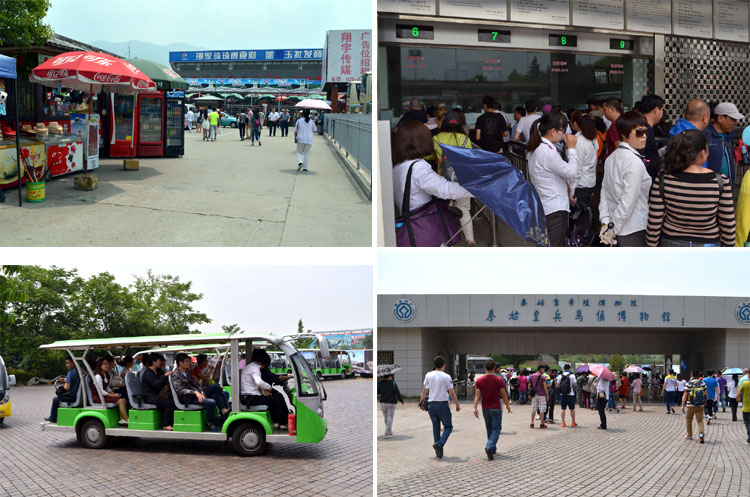
We reached the The Museum of the First Qin Emperor's Mausoleum around 2 pm. There were not many visitors at the shopping area (upper left) but the ticket counter was crowded (upper right). We moved to the entrance of the museum (lower right), which was around 1 km away from the museum buildings. The electric car provides one way trip to the museum buildings, with no extra charge.

We started with the exhibition hall with unearthed artifacts (upper right). The hall was extremely crowded and we could barely find a place to stand, especially in the rooms where the artifacts were exhibited. We could barely hear the explanation from our tour guide as well. Two of the most precious items are the bronze chariots, which were excavated in 1978 (upper and lower right) . The experts spend 8 years to restore the chariots to their present states. Both chariots were carved with stunning details, with even the muscle, joint, and even nails were crafted lifelike. We were lucky to be able to take photos (without flashlight) of the two chariots, as most of the time, we could see only heads of other visitors.

Then, we went to visit no. 1 pit situated on the left side of the museum complex. No. 2 pit is located on the right, while no. 3 pit is behind no. 1 pit.

Closer look at no. 1 pit.

This is what we came for, the terracotta army of Qin Shi Huang! We were waiting, squeezing, and waiting, and squeezing again for more than 10 minutes to see this stunning scene due to the massive crowd there.

A closer look at the army.

The observation platform was extremely crowded. This photo was taken on our way down the right alley.

Restored terracotta- foot soldiers and cavalries. All the soldiers have different expression. They have even different hairstyle.

Restoration in progress- the experts need to reconstruct the damaged terracotta piece by piece like playing jigsaw puzzle.

No. 2 pit was partially excavated. All the terracotta were still burried underground. There were less visitors there.

No 3 pit was much smaller with less terracotta. It had been fully excavated.

This was how the no. 3 pit looks like. Most of the terracotta army placed there were the officers, showing that the pit might be a command office. We could see a worker (in pink) was collecting rubbish which was thrown by visitors into the pit.


We took a rest at the souvenir shop (upper left) and bought a book "An Exploration of the Mausoleum of the First Qin Emperor" with CNY150 (upper right). The person in charge claimed that the book was sold only in the museum. Anyway, it is a book with detailed information about the whole mausoleum with systematic records about the excavation of the burial pits. The best part was, we got the signature of Yang Zhifa (杨志发), the discoverer of the terracotta on our book. For us, it is a book worth reading. We walked for 1 km through a shopping pedestrian street to our bus (lower row).

Next, we stopped by Huaching Gong (华清宫,亦称华清池), the winter palace of the emperors. The palace is also known as Huaching Hot Spring or Huaching Pool. The pool is located at the northern foot of Mount Li, around 30 minutes west from the Qin Emperor's Mausoleum. Originally served as the bathing area for emperors, Xuanzong Emperor of Tang Dynasty extensively built the area into a palace in 723 AD. According to the old inscription, the palace buildings spanned from the top to the foot of the mountain. It served as the living palace for the Xuanzong Emperor and Yang Guifei (唐玄宗与杨贵妃).

However, the palace was not properly maintained after Tang Dynasty. Today, most of the palace buildings there were built in 1980s, based on the record of history. Only the pools and the bathing area are the real relics from the past.

Huaching Pool was also the place where the Xi'an incident took place in 1936, where Chiang Kaishek was forced by Zhang Xueliang to be united with Chinese Communist Party to fight against invading Japanese army. Beside Hua Ching Pool, there are several other bathing pools built by other emperors around the hot spring area.

We couldn't deny that the pool and the palace buildings were really beautiful and nicely maintained. For us, it is a place worth a visit because of our knowledge about the love story of Xuanzong Emperor and Yang Guifei, and how the emperor lost his kingdom because of the beauty. However, it might not be a good place for those who has no idea about these historical characters. With the entrance fee of CNY110 per person, it is expensive compared to the Museum of the Qin Emperor's Mausoleum.

Huaching Pool entrance.

Beautiful scenery of antique Tang Dynasty buildings with Lily Pond (芙蓉池) is what we can see right after the entrance.

Pool of Nine Dragon (九龙湖). Li Mountain can be seen far behind the palace buildings.

Some of the beautiful buildings inside the palace. The royal pools of Tang Dynasty (唐御汤) are located behind the Pool of Nine Dragon (lower left). A big statue of half-naked Yang Guifei was built in the middle of the royal pools area.

Bathing pool specially built for Yang Guifei by Xuanzong Emperor.

The pools built for Xuanzong Emperor (upper left), Taizong Emperor (upper right), and  the servants (lower right) are opened to visitors as well. We have the chance to wash our hand and face with the water from the hotspring at a special area beside the Yang Guifei statue.
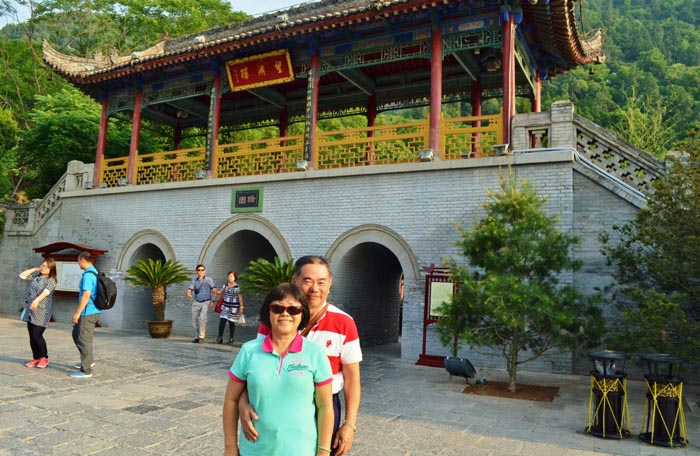
Then, we continued our visit to the former residence of Chiang Kaishek. This photo of Ling Shing's parents were taken at the gate of the residence.

The place is really beautiful. The building with red pillars on the right was the guard house.

Wu Jian Ting (五间厅) behind us was the former office and resting area of Chiang Kaishek.
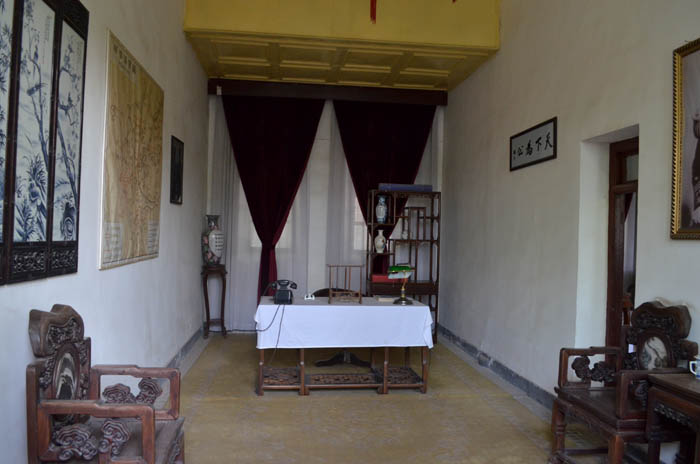
All the furniture was placed at their original places.

We left Huaching Pool at around 6:10 pm and headed to our hotel at Xi'an. We were caught by heavy traffic in the city area, and the trip to Xi An Ramada Hotel took us around 1 hour 15 minutes. Despite tiredness, we still took our opportunity to roam around the Muslim's night market (回民一条街) which is just a few hundred meters away from our hotel. We will share more about the night market and our hotel in our upcoming posts.


Thursday, 25 June 2015

En route vers l'Uber


UberPop n’est pas de l’économie du partage. Bien au contraire, c’est de l’économie du chacun pour sa gueule à l’ère de la débrouille.
C’est aussi une évolution logique du travail et, j'ai bien peur, inéluctable vu l'état d'esprit et l'état politique. Face à un chômage de masse, à l’impuissance des gouvernements, à leur manque de courage et d’imagination à changer de paradigme, chacun s’en sort comme il peut avec la certitude de ne pouvoir compter que sur soi-même.

Je ne défends pas les chauffeurs de taxi pour ce qu'ils sont, mais pour ce qu'ils symbolisent dans ce conflit. J’ai précisé ici que je ne prends que très rarement le taxi, pas assez pour me faire une opinion définitive sur la qualité du service dont à vrai dire je me fous, préférant au final circuler à pied ou en vélo. C’est plus qu’une histoire de course pour une poignée d'urbains ne voyant pas pas plus loin que le bout de leur trajet qui se joue dans la guerre UberPop / taxi. C'est une étape dans l'imprégnation idéologique d’une pseudo "nouvelle économie" qui n’est que l’extension de l’ancienne au cœur de notre quotidien, voire de l'intime. 

Mettons à part la technologie. Il y a dix ans, que des gens louent à des inconnus ce bébé qu’est leur voiture était proprement impensable. Aujourd’hui non seulement ils louent leur voiture, mais ils louent leur temps et le revendiquent. La crise est plus que "passée par là" : elle est stable, durable, avec des pointes de pire. Le salariat n'est plus un objectif raisonnable pour beaucoup, et quand il y a salariat la paye ne suffit pas pour les autres. Le servage free-lance, flexible, à la demande, multicarte, sans droit, ni protection, sans futur, sur application dernier cri, devient peu à peu un modèle viable, bientôt une norme.

Le statut d’Auto Entrepreneur (dont Uber use et abuse) est le marche-pied légal de cette délocalisation interne des salariés (et des chômeurs).  L’uberisation de l’économie est une expression encore trop gentille (et diablement réussie au niveau marketing) pour le retour en arrière qu'à coup d'avancées technologiques le corps social va se prendre dans la tronche en applaudissant des deux mains. C'est le but : vous faire aimer la régression, l'éradication du collectif. Quand vous serez occupés à vous facturer entre proches des prestations de déplacement ou de bien-être, vous en voudrez moins aux responsables de la mise en pièce des services publics, de la santé, de l'éducation (et du transport dans ce cas précis)...

Derrière le prétendu lien technologique, l'économie de la débrouille, centralisée par des sociétés privées délocalisées (spécialement pour leurs bénéfices), sous-entend l'isolement de chacun, et à terme la confrontation de tous (nous ne serons plus qu'un grand marché de concurrents carnassiers).

L'extension de l'überisation dans l'entreprise, c'est aussi l'auto-entrepreneur qui remplacera le salarié (il remplace déjà le stagiaire, trop contraignant malgré sa paye divisée par cinq). C'est "moderne", c'est plus confortable, les salariés préhistoriques n'auront qu'à s'adapter et c'est toujours mieux que le chômage. Et puis tu ne seras plus un salarié avec tout ce qu'il colporte de "vieux-monde", non tu seras "entrepreneur". Ça claque ! Le chauffeur de ta destinée.

Au même moment un film cartonne en salle : "la loi du marché".

Cette époque est uberrante.

Thursday, 18 June 2015

Uber et AirBnB ou l'économie du partage en trompe-l'oeil


Dans le flux de bullshits libérales déversées sur les ondes par les chausse-pieds du capital et autres valets de chambre de la dérégulation sauvage, il y en a une qui a vraiment du mal à passer chez votre rédacteur, c'est le schmilblick ecolo-marketo-geeko-frendly d'économie de partage cité à tort et à travers à propos de tout et n'importe quoi du moment que c'est étiqueté start-up sur la boîte, que la patron a moins de trente ans, un @ dans son nom, qu'il est végétarien et fait du blé en bourse.

Le pompon est décroché ces jours-ci au sujet de ces deux nuisibles arnaques urbaines que sont Über (taxis particuliers) et AirBnb (location touristique entre particuliers) présentées comme fer de lance de la sharing economy.

Je resterai objectif (si si). Je ne paye pas pour voyager chez l'habitant et me déplace aussi rarement en taxi qu'en VTC. Cette polémique de bourgeois fébriles à l'idée de payer sept euros de moins la course, et d'avoir une bouteille d'eau gratuite en prime, ou d'occuper un appartement si authentique, vintage mais confort en plein centre de capitales en pénurie de logement pour les locaux, me touche peu dans mon quotidien. Enfin presque. Je subis juste la pollution des voitures en ville et l'inflation soutenue des loyers depuis cinq ans dans mon quartier parisien (une des conséquences concrètes de l'explosion des deals dématérialisés d'Über et AirBnb). Je ne pleure pas non plus sur les hôteliers ni sur les taxis qui voient leur business déstabilisé par ces deux boites de Pandore.

Ces deux entreprises (peut-on d'ailleurs parler d'entreprises vu qu'elles n'emploient personne et ne détiennent rien ?) préfigurent le carnage social qui va s'abattre sur pas mal de secteurs.

ÜberLiberal et AirBordel sont des entreprises de prédation. La concurrence est faussée, elles se torchent des réglementations nationales (droit du travail, fiscalité) sous les applaudissements de l'upper-middle-class et des cornichons de l'expertise éco au prétexte que, tu comprends espèce de vieux réac et/ou crétin de pauvre, c'est de la nouvelle économie. AirBnB et Uber ne sont en aucun cas du partage et l'inédit y est minime. Un possédant loue un bien, un individu sa force de travail, à un autre individu qui le rémunère pour cela (What a flash ! Je suis bluffé par l'aspect profondément révolutionnaire du paradigme). La seule innovation est l'intermédiation de plateformes numériques COMMERCIALES et délocalisées (qui elles ne partagent pas trop leurs bénéfices économiques avec les services fiscaux du coin parce que "- Hey mec, c'est pas du travail ni de la possession, c'est internet").

Reconnaissons tout de même à AirBnB et Über un concept cynique à souhait (pas étonnant que ces sociétés soient célébrées par l'époque) :  prendre de l'argent sur des biens qui ne sont pas les leurs, faire travailler des gens sans les salarier (donc sans les protéger, sans cotiser, ni leur fournir d'assurance, de congés payés, rien). Mieux encore, dans le cas d'Über, le faux salarié fournit son outil de travail. Le client, lui, à l'impression d'être un peu plus riche. Une belle poursuite de l'ultralibéralisme dont nous sommes cette fois directement les artisans en proposant nos biens, en les consommant, et en travaillant pour ces parasites.

Cette nouvelle économie est de l'ancienne en pire. Il s'agit toujours d'arranger le pouvoir d'achat de ceux qui ont du pognon au détriment des conditions sociales de ceux qui n'en ont pas (en utilisant de jolis mots pervertis comme "partage", "modernité" et autre "collaborative"...).

Que trouvera-t-on au bout d'Über et AirBnb ? Augmentation des loyers pour les locaux non BnBaiseurs (autrement nommé les pauvres), désagrégation de la protection sociale pour les chauffeurs (et de leurs revenus une fois que tout le monde sera chauffeur Über, et qu'un nouveau service Über te proposera d'être véhiculé au tiers du prix en chaise à porteurs. Bah quoi, c'est bien puisque c'est bio. Tu pourras enrichir l'expérience sociale de coups de fouet sur tes prestataires collaboratifs de trajet, ce qui, nous en sommes convaincus, même en option payable d'avance, aura encore plus de succès que la bouteille d'eau en libre accès.

Articles connexes :
Salarié, upgrade-toi !
Dissolution des salariés
Paris, ville ouverte (à AirBnB)

Dengfeng Shaolin Temple and Guanlin Temple (Henan and Xi'an Tour Day 4)

We continued our trip to Dengfeng Town and Shaolin Monastery in Songshan (嵩山). Of course, Shaolin Monastery was the highlight of our fourth day tour. We started our journey from Xinmi at 9 am, and reached Dengfeng at around 9:30 am. Dengfeng has numerous Chinese martial art schools and many of these schools claimed to have certain connection to Shaolin. Of course, we couldn't know how true it was, but for sure, Shaolin has successfully developed "kungfu ecomony" at Dengfeng. 

Our first stop at Dengfeng- Shi Xiaolong Martial Art School to watch a wushu show by a group of school children. The students there had performed very well. However, we had expected more. Well, maybe we watched too much movies about Shaolin kungfu, such as the one produced by Jason Scott Lee.

Songshan can be seen from Dengfeng town.
Shi Xiaolong Martial Art School houses a few thousand of students. They have martial art practices integrated into their curriculum. We found the short form of the school name in English was pretty cool- SLSXLWY.

The wushu performance.

 Photo with the performers.

We took our steamboat buffet lunch at Shaolin International Hotel, Dengfeng. The meal was nice with wide variety of choices. The normal price for the meal was CNY58 per person but for us, it was included in our tour package.

Travel by bus, Shaolin Monastery is 30 minutes from Dengfeng Town. Surrounded by Songshan (嵩山) or Song Mountain, the view there was stunning. Built in year 495, the temple has been established for more than 1500 years. Legend says the temple was the birth place of kungfu.

Driven by the expectation to see old temples and sifus with awesome kungfu, we met with the biggest disappointment of our tour- we found relatively new temple buildings with a few young monks selling books, souvenirs etc., watching over the temple, and playing with their smart phone under the shady roof. The scene was totally out of register with the Shaolin Temple in our mind.

Later, we found out that Shaolin Monastery was partly destroyed by bandits (in 1359), rebels (in 1641), several times by the rulers, and almost totally devastated by a warlord in 1928. Most of the buildings that we saw was built after 1980. The only real relics that we can see in the monastery is the Hall of Thousand Buddhas (千佛殿), which was built in 1588. 

Through the visit, we also learned that Shaolin kungfu is about practice and meditation (禅武). It is not a kind of wushu or fighting skill. Shaolin kungfu is not exist overnight, but a result of enhancement and refinement over a long period of time. We found a good video showing the history of Shaolin in Chinese. Today, monks are still practicing kungfu as their daily routine, but not at the tourist area.

We paid CNY100 to enter the gate of Shaolin, and the two ways ticket with electric car for CNY20. Taking the electric car is advised as the monastery is quite a distance away from the main entrance. As the temple complex at the tourist area are relatively new, it will be less interesting to visit the place without a guide to tell us the story behind the building. Of course, we can always read more about Shaolin Monastery and its history prior to our visit. We spent three solid hours in Shaolin Monastery and Pagoda Forest.

After lunch, time to pay our visit to Shaolin Monastery 30 minutes from Dengfeng Town. The hills around the temple area can be clearly seen from the carpark (upper left). A stone nearby the entrance with words carved "the culture of Shaolin is a heritage of humanity" by Jiang Zhemin- former General Secretary of the Communist Party of China (upper right). We walked through the gate to the Shaolin Monastery (lower right) to reach the electric car station.

The mountain gate (山门) with the words Shaolin Si caligraphed by Emperor Kangxi of Qing Dynasty in 1704.

The shady walkway with steles is dubbed as beilin (碑林) or the forest of steles (upper left). A 1500 years old Ginko tree is an attraction to the tourists at the end of beilin (upper right). Steles erected in 728 AD stated the history of how the 13 monks helped Emperor Li Shimin of Tang Dynasty won his battle over his rivals (lower right). The scripture room is now a house of a reclining Buddha.

A stone stele written by Jinyong (金庸), a famous Chinese novel writer.

The buildings around the monastery are beautiful, but relatively new with less historical value.

Two very old antiques in the monastery- the wok and the stone mill in front of the scripture room (upper row). Lixue Ting was built according to the plan of Bodhidharma Bower (达摩庭) (lower left), with the sculpture of Bodhidharma placed not far from the bower.

Hall of Thousand Buddhas (千佛殿) is located deep inside the monastery (upper row). The 48 depressions on the floor were believed to be formed by the "qi" channelled by the monks when they practiced kungfu in this hall (lower right). The picture of 500 luohan was drawn on the wall of the hall.

Talin (塔林) or Pagoda Forest is 10 minutes walk from Shaolin Monastery. The place serves as tombs for eminent monks and abbots. Pagoda Forest is filled with pproximately 240 pagodas, with the oldest one built in 618 AD. The whole Pagoda Forest was fenced.

The pagodas were built with either three, five or seven levels, representing the status of the deceased. 

Beautiful scenery at Songshan. The shopping area at the gate of Shaolin was not very attractive. We can get items with low price if our bargaining skill is good.

Ranked top among five great mountains in China (五岳山), Songshan is dotted by many temples and breathtaking sceneries. Our original plan was to visit Sanhuang Zhai (三皇寨) by cable car, not far from Shaolin Monastery. However, the cable car was closed for service during our visit so we chose to skip Shanhuang Zhai monastery and continued our journey to Luoyang (洛阳). 

Now, if you ask, is Shaolin Monastery worth a visit? We would say yes. However, we would advise to skip the kungfu show at Dengfeng and go straight to Sanhuang Zhai Monastery after visiting Shaolin Monastery and Pagoda Forest. Without cable car, visiting Sanhuang Zhai will be time and energy consuming. See this page for more information about Sanhuang Zhai.

5:30 pm, we reached Luoyang City. We paid a visit to Guanglin Temple (关林), the burial site of Guanyu's head. Guanyu (关羽) was a great general of Shu (蜀国) during Three Kingdom's period (after Han Dynasty). He was famous due to his loyalty and his mastery of military strategies. He was beheaded by his rival from Wu Kingdom (吴国) with his head sent to another rival- Caocao of Wei Kingdom (魏国). Out of respect, Caocao (曹操) buried Guanyu's head with great honour outside of Luoyang around 1800 years ago.

Guanyu is the only legendary figure respected by Confucians, Buddists, and Taoists, whose the tomb had been patronized by many emperors, and worshipped as god by both gangsters and police forces in Hong Kong movies. Again, in order to pay our respect to this legendary hero, we need to pay CNY40 of entrance fee first.

The entrance of Guanlin (upper left) leads to the temple of Guanyu, which was built around 1600 AD (upper right). According to history, Guanyu used double swords and spear in battlefield instead of 70 kgs-dragon-sword as described in novel (lower left). Guanyu mastered the military strategies from books he read. His face was originally pale, but was painted red by his worshippers as a reflection of his personality.

A gazebo built by Emperor Kangxi in 1666 AD with a wooden stele declares the sanctification of Guanyu. 

Is Guanlin a must visit site in Luoyang? Yes, only if you are a big fan of this hero. In fact, there was little information about Guanyu available in the temple, and it would be quite boring if we came without prior knowledge about him. For those who are worshipping Guanyu as a god, it might be a disappointment to know the truth that the beheaded god. Isn't it a better choice to worship the person who beheading the god? Well, sometimes, the religion matter might not appear to be in alignment with our logic.

We dined at a very special restaurant in Luoyang- no ice cube provided. Anyway, the food served was nice. We stayed in Lee Royal Hotel Mudu, Luoyang and experienced local Chinese style massage there. The hotel has impressive lobby, comfy room and nice breakfast. We were just a bit not used to the open concept washroom and bath tube (transparent glass partitions without curtain). 

We found the truth of Shaolin Monastery and General Guanyu in our day 4 trip. Day 5, we had Longmen Grottoes (龙门石窟) and Museum of Luoyang Eastern Zhou Royal Horse and Chariot Pits (洛阳天子驾六博物馆) in our itinerary.


Henan Museum and Huang River Scenic Area (Henan and Xi'an Tour Day 3)

Day 3, we visited Henan Museum (河南博物院) and Huang River Scenic Area (黄河游览区) in Zhengzhou City (郑州). Zhengzhou is a fast developing city with modern high rises sprouting at a tremendous fast pace. From our hotel, we took around 30 minutes to reach Henan Museum and spent 1 hour 30 minutes there.

Henan Museum in Zhengzhou is not big. But the museum houses more than 130 thousand artifacts with a few of them dated 8000 years ago. This makes Henan Museum one of the 8 major museums in China.  The entrance fee was CNY20, with guide available with CNY100 - 200. Hiring a good guide worth all our money spent. For us, the guide had done an excellent job to walk us through 8000 years of history in 45 minutes. Alternatively, we can buy a complete guide of the museum (河南博物院-带你走进博物馆) from the museum bookstore with CNY25 and spend a few hours reading it before the visit. To know more about this museum, you can visit its official site. For us, Henan Museum is a must visit site in Zhengzhou. By the way, most of the information inside the museum are available in both Chinese and English.

Zhengzhou is a fast developing city. We had our dinner at Zhengdong CBD (郑东新区) a night before (upper row). The new high rises are much more taller than the old ones (lower right). Some of the roads at older township are nicely shaded by trees.

The museum building resembles the oldest observatory platform in China discovered at Dengfeng, Henan. 

The hall with the sculpture representing "human determination can conquer nature" (人定胜天)(upper left). The man pushing two elephants away is a symbol of Henan "豫" as well. Oracle (甲骨文)- the oldest  mature written character in China (upper right), jade garment knitted with golden thread (金缕玉衣)- a symbol of desire to be immortal (lower right), and the 8700 years old bone flute made by crane's ulna were some of the artifacts exhibited in the museum. 

How to determine Tang Dynasty's artifact? Well, it was the only dynasty in China where chubby was considered beautiful.

Lunch at Zhengzhou Dayali Restaurant (大鸭梨). The food were nice and the most special one- roasted duck with vegetables wrap was really delicious.

After lunch, we drove 40 minutes to Zhengzhou Huang He Scenic Area (黄河游览区). Huang He (黄河) or Huang River, the second longest river in China and the sixth in the world, with estimated length of 5500 kms, is called the cradle of Chinese civilization. 

In the scenic area, we had the chance to cruise on the river with hovercraft, walked around the bank of Huang He, and took a look at the stone sculpture of Yan Di and Huang Di (炎帝和黄帝). We spent around 1 hour on the hover craft trip (including waiting time) and 15 minutes at the square where the sculpture of two kings located. We paid CNY60 to enter the scenic area, and extra CNY80 for 40 minutes of hovercraft ride. 

The Huang He Scenic Area that we visited was quite far away from Zhengzhou City. For us, it was a pretty cool experience cruising on Huang He as "Huang He is hard for cruising" (黄河自古难行船). There is a local say that "one won't be satisfied without cruising on Huang He" (不登長城非好漢,不遊黃河心不甘) as well. Recommended? Yes, but sincerely, it is not a must. If you are not a "fan" of that particular river, you might opt to skip this site.

From the entrance of the scenic area (upper left), we drove another few hundred meters to the harbor of hovercrafts (upper right). The control panel of the craft looked antique (lower right) but the ride was comfortable with clean and air conditioned cabin. The craft cruised upstream and landed on an area for us to walk along the riverbank.

Our landing site was just beside the Zhengzhou Taohuayu Huanghe Bridge (郑州桃花峪黄河大桥). The scenery there was great, but a chance to step on the sand of Huang He was even greater. Our tour guide told us that it was not a good idea to wash our face in Huang He, as the high content of sand would make our face even dirtier than before. That's why a Chinese idiom says "couldn't get cleansed by jumping into Huang He" (跳进黄河洗也不清).

The hovercraft can cruise on land (upper left) thus suitable for cruising around Huang He area. The river is shallow, due to the sendimentation of sand. During the cruise, we were brought to cross the borderline between downstream and midstream of the river- Taohuayu (桃花峪)(upper right). We rent a horse ride with CNY10 (lower right). Chuhe Hanjie (楚河汉界) is located behind the hills not far away from where we had our horse ride.

It is really hard to cruise with boat on Huang He, as the river is really shallow due to the sedimentation of sand washing down from the midstream of the river. According to Wikipedia, the average sand content in 1 meter cube of water was 3.5 kgs.

The gigantic sculpture of two kings- Yan Di and Huang Di (炎帝和黄帝). The sculpture was made by stone, 100 meters high, with a large square in front of it. The sculpture was completed in 2007, after 20 years of construction. 

Commemorating great historical figures (or more to legendary figures) is good, but is it necessary to build a stone sculpture that size?

After leaving Huang He Scenic Area, we travelled 1 hour 40 minutes to Xinmi (新密), a small town 40 kms northwest from Zhengzhou City. We arrived at Cheered Hotel (承誉德大酒店) at 5:30 pm and took our dinner at the hotel around 6:30 pm (upper left). The hotel owned a nice garden (upper right). Ranked no 1 in Tripadvisor, the hotel provided excellent service and to our surprise, the staff actually lined up and bowed to us when we left the next morning. Cheered Hotel is located a few kilometers from the town center.

Well, after one day trip at Zhengzhou, we took our rest at Xinmi. Staying in Xinmi shortened our distance to visit Shaolin Temple at Dengfeng the next day.